A Cleaner Picture
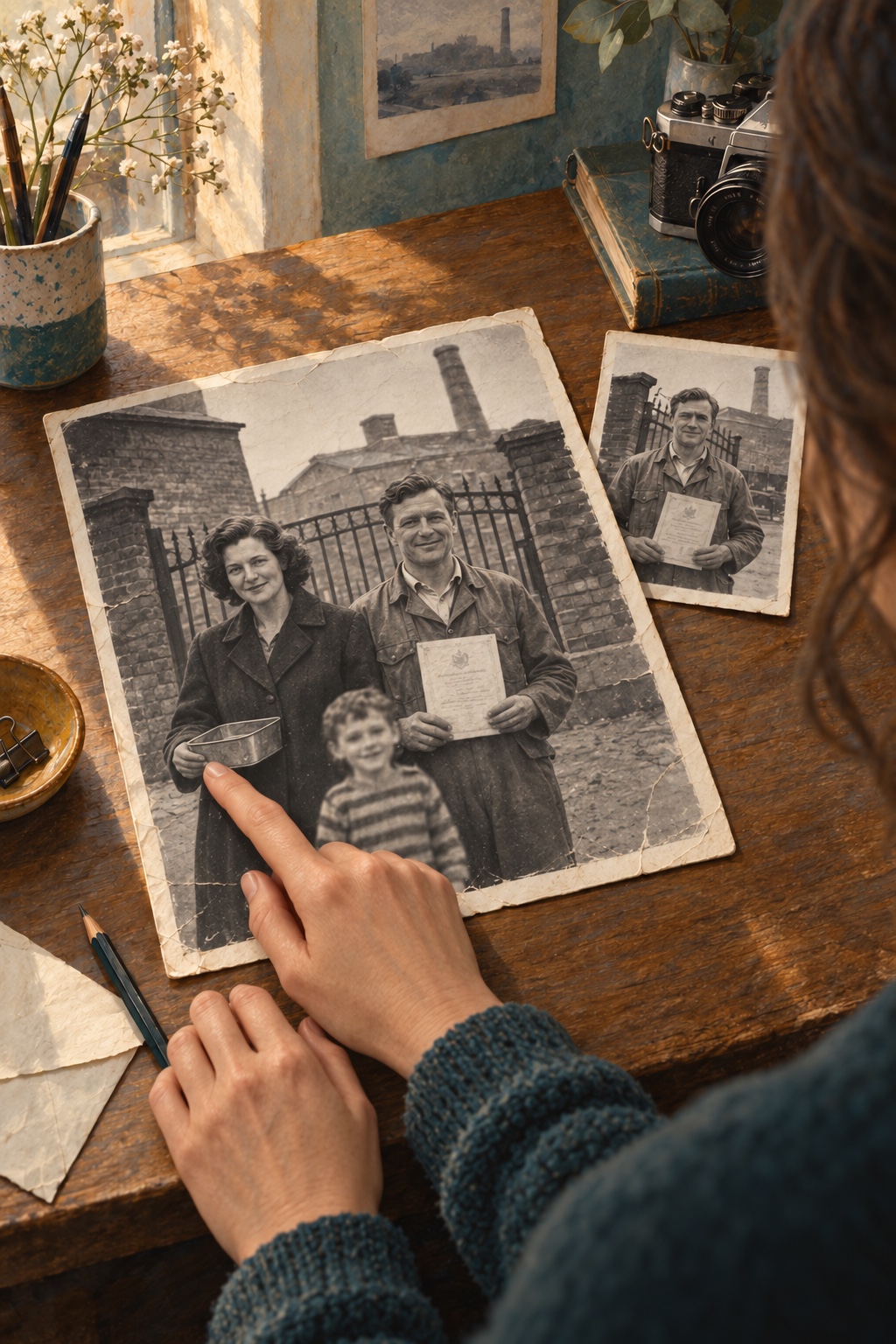
The first thing Nora removed from the photograph was her mother's hand. It appeared at the left edge, holding a square metal tin. The rest of her mother was outside the picture. Nora moved the border a little, and the hand disappeared. Without it, the photograph looked balanced: her father stood beside the factory gate, a certificate against his chest. Behind him, the windows caught the afternoon light. She saved the new version and opened the next file.
For three weeks, Nora had been preparing photographs for a hotel that was opening in the old factory. The manager wanted twelve pictures for the entrance hall. Nora needed the money, but she also wanted a project she could show to other clients. Until now, most of her work had been portraits and pictures of objects for small shops. This was her first exhibition. She had spent hours removing dust marks from the scans. She wanted people to notice the pictures, rather than the work behind them.
Her father had worked at the factory for thirty years. He had died when she was seventeen, and she remembered him through a few sharp scenes: his boots under the kitchen table, his careful way of peeling an orange, the proud smile in this photograph. She remembered the day of the picture too. She had been eleven. There had been music, cake and people laughing beside the gate. Years later, her mother had given her the photograph in an envelope. Nora had never asked who had taken it.
When the manager visited her studio, he stopped at the image. "That's exactly the feeling we're looking for," he said. "Warm. Personal. People who cared about the place." Nora explained that the man was her father. The manager suggested a caption: "A proud worker celebrates thirty years of service." It sounded reasonable. The certificate was real, and the photograph showed a celebration. She wrote down the sentence. Before leaving, the manager asked whether the pictures would be ready by Friday. She said they would.
That evening, Nora brought a small print to her mother's flat. Her mother was cleaning an old lamp, with its shade and screws arranged on a towel. She looked at the print without touching it. "You've cut the tin out," she said. Nora explained that the hand had been distracting. Her mother placed the lamp's wooden base on the table. "It was a cake tin," she said. "I can see why you wouldn't need it." Her voice was calm, but she turned the print over before Nora had finished explaining the caption.
"Wasn't it his anniversary?" Nora asked. Her mother ran a finger along a dark mark on the lamp. "It was several things." Then she asked about the hotel: how many rooms it would have, and whether they had kept the large windows. Nora answered, wondering why her mother had chosen these questions. On the journey home, she pictured the hand she had removed. It had seemed like a mistake at the edge of a good photograph. Now it felt like the beginning of a question.
What the Tin Carried
The next morning, Nora searched the envelope again. Under a strip of folded paper, she found a smaller photograph she had overlooked. It showed the same gate from farther away. Her mother stood beside her father in a dark coat, holding the tin. A child in a striped shirt was watching someone outside the frame. Nora recognised the shirt before she recognised herself. On the back, her father's writing said, "Last afternoon. Home before the rain." There was no date, and nothing about an anniversary.
She called her mother. "Was the factory closing that day?" There was a pause. "Our part of it was," her mother said. "They kept one building open for another year. You used to see lights there and think everything was the same." Nora remembered those lights. Her father had later taken a job repairing doors at a school, but she had never connected that change to the photograph. "You were eleven," her mother added. "We didn't explain every worry to you." Nora asked whether she could visit again, this time with the envelope.
Her mother made tea and set both photographs on the table. The lamp was working now. "They gave him the certificate because it was his last day," she said. "Thirty years, and they still managed to spell his first name wrong." Nora leaned closer. The writing was too small to read in the print, so her mother found the certificate in a drawer. One letter was wrong. Nora remembered her father checking the spelling on her school forms. She had polished the image without seeing something he would certainly have noticed.
"I thought you brought a cake for him," Nora said. "I brought the tin home," her mother replied. "Empty. Everyone had eaten the cake." She smiled briefly. "He did laugh that afternoon. Your memory isn't false." Then she opened another drawer and took out a small cloth bag containing two screwdrivers and a narrow pair of pliers. She had brought those home as well. She had worked in the factory's repair room for twelve years. When the machines stopped, the tools were no longer needed there.
Nora knew that her mother had once worked at the factory, but she had imagined sewing, or packing boxes. "You repaired the machines?" "Some of them. Small problems, mostly. A loose screw can stop a great deal of work." Her mother picked up the pliers. "Your father used to bring difficult jobs to me." Nora looked at the lamp and felt embarrassed by her surprise. For years she had accepted her mother's practical skills as something that simply happened around her: a working lamp, a straight shelf, a door that closed.
"Can I use the wider picture?" Nora asked. "And write what you've told me?" Her mother shook her head. "I don't want strangers feeling sorry for us every time they arrive with their suitcases." Nora began to explain that she wanted to be accurate. "I know," her mother said. "But you have a photograph. You don't have permission for every part of my life." Nora put down her pen. She had arrived looking for a better caption. She left with the photographs, her notes, and no agreement about what she could say.
The Space Around a Face
On Wednesday, the manager sent Nora the designs for the entrance hall. The photographs would hang beside a long bench, above a neat line of captions. Her father's picture appeared near the front door. Under it was the sentence they had discussed. Nora stared at the word "celebrates". Her father had smiled; that did not prove what he had felt all afternoon. She wrote to the manager asking to replace the picture and caption. She attached the wider scan, but kept her mother's account out of the message.
The manager called within an hour. "This version has a lot going on," he said. "The smaller one is stronger." Nora agreed that the original crop was visually simpler. "But the caption makes the day sound simpler too," she said. "I now know it was his last day at work." The manager was quiet. Then he asked whether they could keep the crop and remove the caption. It was a practical suggestion. Nora almost accepted it. She had already completed the agreed work, and another client's order was waiting.
Instead, she asked for one day to prepare an alternative. She would keep the same number of pictures and the same deadline. The manager agreed to look at it, but warned that he could not promise to change the design. After the call, Nora opened both scans. The wider picture was less clear. A pale scratch crossed her mother's coat, and the child's face was blurred. She could repair the scratch; she could not bring back detail that the camera had never captured. She decided the blur could stay.
That afternoon, Nora asked her mother to come to the studio. She placed three prints on the desk: the cropped picture, the wider one, and a close view of the original certificate. Her mother studied them slowly. "You don't need the certificate," she said. "One wrong letter isn't his whole story." Nora put that print aside. Then she explained the manager's suggestion. Her mother touched the corner of the wider image. "I prefer this one," she said. "But I don't want you writing that we were frightened. We were, sometimes. We weren't only that."
Nora gave her a blank sheet of paper. "What would you want someone to know?" At first, her mother said she was no good with words. Nora waited, and did not reach for the pen. Eventually, her mother wrote three sentences, crossed out the second, and began again. The final version read: "This was our last afternoon at the factory. We had worked in different rooms, and we were going home together. The cake tin was empty by then." She read it aloud, then added her name: Leila.
Nora asked whether she could explain that Leila had repaired machines. "In one sentence," her mother said. "And let me see it first." They settled on a short introduction identifying the two workers and their jobs. Leila read the complete caption and agreed to it. Nora photographed the paper so she would not lose the wording. Before leaving, Leila noticed that one leg of the desk was uneven. She folded a piece of cardboard and slipped it underneath. "There," she said. "Now you can write without shaking the whole table."
A Picture That Could Stay
On Thursday morning, Nora showed the new design to the manager. She had adjusted the wider photograph to fit the existing frame. She had removed the dust and the scratch, but left the blurred child and the uneven line of people at the gate. Leila's words appeared underneath, with her name. The introduction was brief: her father had worked in the cutting room; her mother had maintained the smaller machines. Nora showed the manager the agreed caption before explaining why she wanted to use it.
He read it twice. "It changes the mood," he said. "Yes," Nora replied. "But it doesn't tell people how to feel." He looked from the tin to the child in the striped shirt. "That's you?" Nora nodded. "I remembered a party. She remembered packing up. Both things were happening." The manager walked away to answer a call. While she waited, Nora noticed how badly she wanted his approval. She also knew that, if he refused, she could offer another photograph. She would not return to the old caption just to finish the job.
When he came back, he agreed to use the wider picture. He asked Nora to shorten the introduction so it would match the other captions. She did, and sent the revised wording to Leila before printing. They did not add a full account of the closure. There was no room for it in this display, and Leila had not offered one. Nora checked the other eleven captions, replacing two confident claims with descriptions of what the pictures actually showed. Where she still had questions, she left the labels shorter.
At the opening on Friday, Leila wore a green jacket Nora had not seen before. She stood in front of the photograph for a long time. A visitor nearby asked whether the tin was a lunch box. "Cake," Leila said. "A very large cake." The visitor laughed and asked if she was the woman in the picture. Leila said she was. Nora moved towards them, ready to explain, then stopped. Her mother was already describing the repair room. She held out her hands to show the size of a little motor.
Later, Nora asked whether the picture had been all right. "The wall is a little dark," Leila said. "But yes." Nora laughed, relieved by such a practical answer. They sat on the bench while guests passed through the hall. Some read the caption. Others barely looked at the photograph. Leila did not seem troubled by either response. After a while, she asked if Nora had eaten. They left the hotel and bought sandwiches at a shop across the street, where Leila found a crumb on Nora's sleeve and brushed it away.
Back in her studio, Nora opened the folder containing the original scans. She kept the early crop, but moved it into a folder marked "Unused versions". She saved the final caption beside the wider picture. Then she enlarged the child in the striped shirt. The face remained a blur. She could remember the cake, the noise, and the promise that they would get home before the rain. Now she knew a little more about what the adults had carried away. At the left edge, her mother's hand held the empty tin, steady and plainly visible.