The Empty Chair
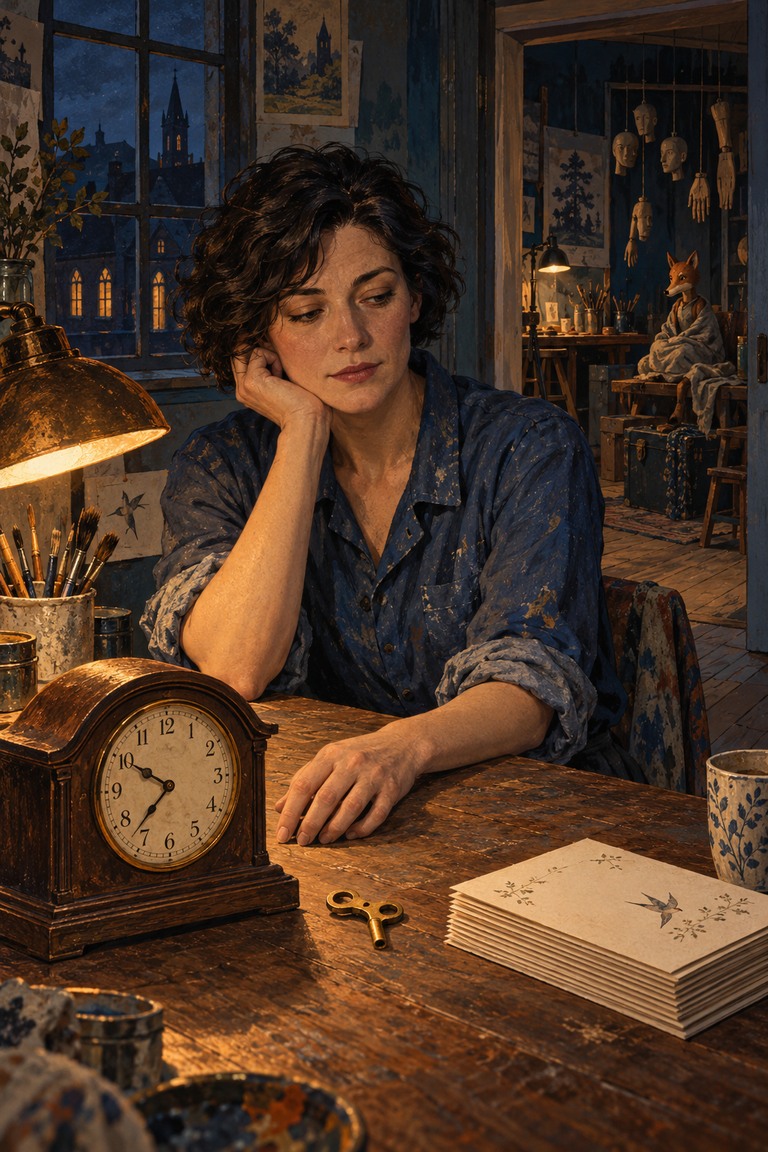
Mara put the black knight in the wrong place, then blamed the light. It was a small mistake, easily corrected, but she glanced towards the door before moving it. For eighteen years she had arranged the boards at her brother's chess club without sitting down at one. She carried chairs, found pencils and made tea. If a player failed to arrive, she preferred to leave an empty chair rather than take it herself. This Sunday, however, there were twenty chairs and twenty-one names. The extra name, written in her brother's unmistakable capitals, was hers.
"It is a practice afternoon," Eli said. "Nobody is keeping a league table." He was balancing a box of clocks against his stomach, already prepared for an argument. Mara held up the sheet. "Then you can practise asking people before you volunteer them." He looked embarrassed, which annoyed her more than a joke would have. She could have refused him easily if he had laughed. "I thought it might be easier this way," he said. She folded the sheet along an existing crease and put it beside the kettle. "Easier for whom?"
Across the room, a girl in a yellow jumper was studying an arrangement of pieces. Her name was Sol, and she came every week with a notebook that contained almost no writing. Instead, she drew arrows, little storms and faces with exaggerated eyebrows. Mara had once asked whether these were diagrams. "Sometimes," Sol had said. "This one is how I felt when I saw the move." Now the girl approached with the notebook open. Eli had promised her that Mara would explain an old game after lunch. On the page, beside a drawing of a crown, she had written Mara's name.
The game in question had ended in a victory. That was the part everyone remembered. Eighteen years earlier, Mara had been selected for a regional team after defeating Leon Vale, a player whose name still appeared on the club's oldest trophies. Eli had framed the little results sheet. Mara had asked him to take it down; he had moved it to his office instead. In the final minutes, Leon had looked at the wall clock, made a hurried move and left. His mistake had given Mara an opening, but he had conceded the match before she could use it. Soon afterwards, Leon had moved away. A week later, Mara had declined the team place.
She had never explained the connection. People supplied explanations of their own: work, nerves, an unwillingness to travel. Mara let them. What she remembered was Leon's glance at the clock and the weary kindness she thought she had seen in his face. He had been much stronger than she was. Perhaps he had decided that an ambitious young woman needed a victory more than he did. The possibility had worked its way into every memory of the match, until even her earlier, careful moves seemed to belong to somebody else's generosity. Then the club door opened, and Leon stood beneath it, holding a canvas bag.
A Different Account
His hair was white now, although his eyebrows had remained stubbornly dark. He recognised Mara before Eli could introduce them. "You used to sit with your back to the window," he said. "The light bothered you." It had, but she had forgotten. He shook her hand with neither ceremony nor apology. Eli took his bag and began talking too quickly about lunch. Leon had returned to the area to live near his daughter; this was his first visit to the club in years. Mara could see her brother calculating the distance between two convenient empty chairs.
She escaped to the kitchen, where Sol followed her. "Will you show me your game?" the girl asked. "Your brother says you won against him." Mara reached for a cup and began washing it, although it was clean. "My brother says a great many things." Sol considered this distinction. "Did you win?" "According to the results sheet." The girl looked from Mara to the cup. "That sounds like an answer to a different question." Mara turned on the tap. The water struck a spoon with a sharp, repetitive note. She had meant to protect Sol from a disappointing story. Instead, she had made the girl work to understand a simple answer.
After lunch, Leon found her at the table by the window. He had brought the canvas bag back from Eli's office. Inside it was an old chess book with loose papers between the pages. "Your brother asked whether I still had the record," he said. "I wasn't certain, but here it is." He unfolded a sheet covered in cramped handwriting. Mara recognised the date before she recognised the moves. A tea stain occupied one corner, obscuring several numbers. She took out her own copy from the back of the club's drawer. Hers was cleaner and almost blank at the end.
They arranged the pieces according to the two accounts. Where Mara had stopped writing, Leon had continued. She remembered the pressure of that afternoon, the room growing hot and her own breath becoming something she could hear. He remembered a chair leg that wobbled. They agreed on the position before his hurried move. Beyond that, their memories separated. "You saw I could win," Mara said, keeping her eyes on the board. "And you let me." Leon looked at her. "Is that what you thought?" His surprise was immediate, almost impolite. She found it more convincing than a careful denial would have been.
His father had been living alone then. During the match, a neighbour had telephoned the club to say that he had fallen and was waiting for help. Eli had been away that afternoon; another volunteer had passed Leon a note. Leon had believed he could finish quickly. When he realised he could not, he made the move and left. "I should have stopped the game," he said. "I was thinking about the journey. Then I was thinking about why I hadn't already begun it." Mara remembered a folded scrap of paper beside his elbow. In her memory, until that moment, it had contained nothing at all.
"You might still have won," he added. "I might have won the next five games. We cannot recover either possibility from this sheet." Mara had expected relief to be straightforward. Instead, she felt it mixed with an unreasonable resentment. She had surrendered a team place to an interpretation nobody had asked her to make. Yet Leon's explanation could not give the place back, and she disliked the impulse to demand something equally valuable from him. He began putting away the pieces. "Your brother has paired us for a game this afternoon," he said. "I told him you would have to agree first."
The Afternoon Clock
Mara went to the kitchen and found Eli cutting a cake into portions of heroic inequality. He began defending the afternoon before she had said anything. "I didn't know about his father," he told her. "I thought you were tired of competing. Every time I asked, you changed the subject." She watched him adjust two slices until both were smaller. "So today you decided to choose for me." He put down the knife. "Yes," he said. The absence of an excuse left her with nothing useful to argue against. She asked him to take her name off the sheet, then went back to Leon and offered to play.
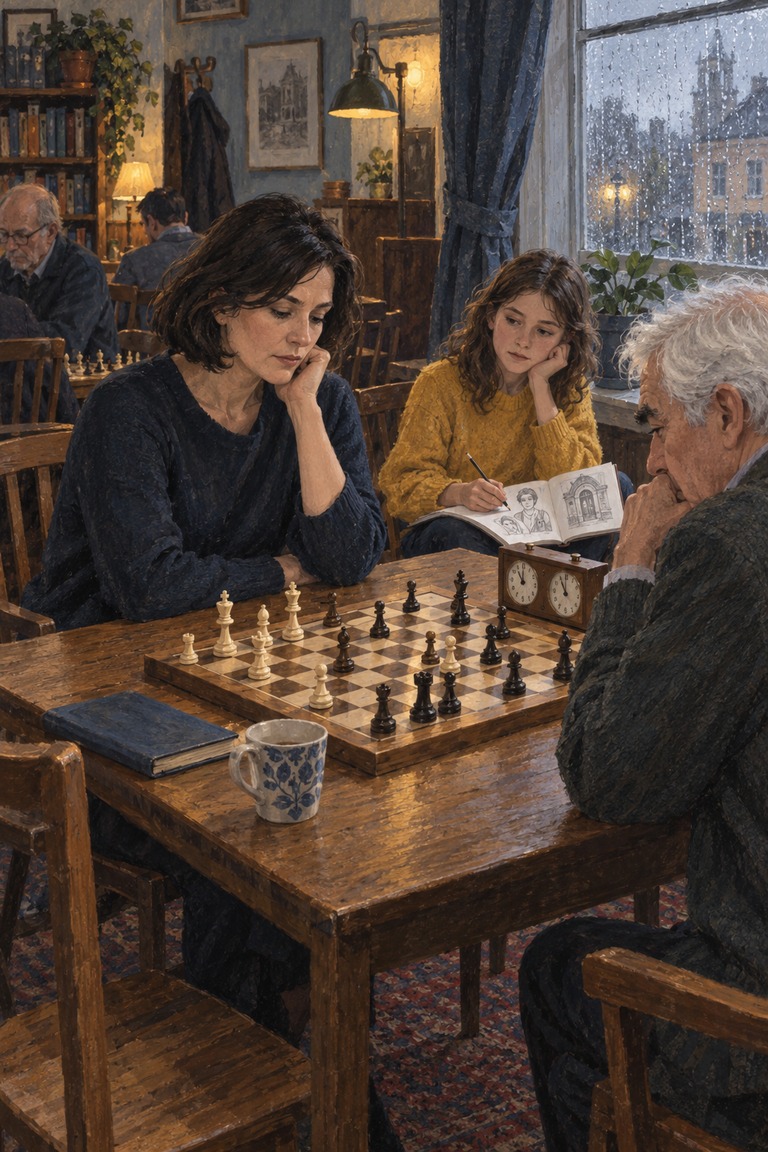
They chose the board near the window. Mara sat facing the light this time and pulled the curtain halfway across. Leon put his phone beside the board, face down. At the club's practice afternoons, players could agree to pause their clock; there were no official results to submit. Even so, Mara asked for a clock. She wanted to feel the shape of a real decision, with time being used rather than politely forgotten. "Forty minutes each?" Leon asked. She nodded. Sol brought her notebook to the next table, then looked towards Eli before sitting. "May I watch?" she asked Mara. Mara moved a spare chair towards her.
The first few moves were familiar enough to make Mara suspicious of her own comfort. Her hands knew where to go. Her thoughts arrived a little later. She recognised an arrangement she had studied years ago, but could not remember what she had intended to do with it. Leon waited while she considered. His patience felt, for an instant, like the beginning of another favour. She looked at his clock and saw that it was her time running. He was simply waiting for his turn. That should have been obvious. She moved a pawn, pressed the clock and released a breath she had been holding too long.
Sol began drawing. Mara could see a narrow doorway in the corner of the page, followed by a smaller doorway inside it. At the board, Leon offered an exchange that would simplify the position. Mara could accept it and remain reasonably safe. She could also refuse and keep a more difficult position, one in which both players would have to find their own way. The second choice attracted her, partly because it was interesting and partly because an audience of one had become an audience. She caught herself imagining the story Sol would tell afterwards. Then she looked again, separating what she wanted the move to mean from what it might actually do.
She refused the exchange. Several moves later, she saw a weakness she had overlooked. She was reaching towards a piece when Leon's phone vibrated against the table. His hand moved towards it, then stopped. The sound repeated. Mara felt the old afternoon return with an accuracy that no results sheet could provide: clock, hurried hand, her own need to interpret another person's face. "You can answer it," she said. Leon stepped into the corridor. She kept her hand away from the board. Sol closed her notebook. Neither of them spoke until he returned.
His daughter had locked herself out of his flat, where she was feeding his cat before leaving for work. The spare key was in Leon's bag. She had a bus to catch and could not wait until the end of the game. He looked at the board, visibly irritated with the timing. "It is ten minutes there and back if I walk quickly," he said. Mara almost told him to take as long as he needed. The words would have sounded generous, and she could already imagine their bitterness if he never came back. Instead, she asked, "Do you want to return and finish?" "Yes," he said. "Then let us pause for fifteen minutes. If it takes longer, call the club."
The Game That Happened
Eli stopped the clock and wrote the time on a slip of paper. Mara asked him to keep the board exactly as it was. Leon took his bag and left; Sol watched the door close. "I thought you would tell him the game didn't matter," she said. "I nearly did." "Does it?" Mara looked at the position she had chosen. "I would like to finish it." Sol reopened her notebook. "My dad says I should enter the junior competition. I want to, but he keeps saying it will look good on applications when I'm older. That's a strange reason to do something now." She drew another doorway and rubbed it out.
Mara recognised the temptation to make Sol's question smaller by supplying a large answer. She could offer one of the speeches people made about winning and effort. But Sol had seen her hesitate before sitting down, and a speech would not explain that. "What do you like about it?" she asked. Sol turned the notebook so Mara could see a page of tiny faces. "There is a bit when I find something I didn't know was there," she said. "Even when it doesn't work." Mara studied the faces. Some were triumphant; several looked thoroughly annoyed.
Leon returned in twelve minutes, without the canvas bag. His daughter had taken the bag with her so she would not lose the spare key. "The cat refused to acknowledge my contribution," he said, sitting down. Eli read the time aloud and restarted the clock. The joke helped, but the position was still difficult. Mara could now see two ways of defending herself. One would postpone the trouble; the other depended on an assumption about Leon's reply. She examined the assumption until it no longer seemed like evidence. Then she chose the first way. Across from her, Leon nodded slightly and began thinking. She did not decide what the nod meant.
The game lasted another half hour. Mara found a resource that briefly surprised Leon, and for three moves she thought she might escape the difficulty she had created. Then he found an answer she had missed. There was nothing theatrical about the ending: no sudden collapse, no final trap. Her possible moves became fewer, and each one made his task a little easier. At last she stopped the clock and held out her hand. "I think that's yours," she said. Sol was watching closely. Mara waited for disappointment to pass through the girl towards her, as if it were something being handed across a table. Instead, Sol bent over her notebook and drew a face.
Leon asked whether they should examine the position where he had offered the exchange. Mara agreed. They replaced the pieces, argued about two possibilities and discovered that one of Mara's ideas was better than either had thought during the game. That did not change the result. Nor did it make the mistake she had actually made disappear. She wrote both moves in Sol's notebook, beside a storm with enormous eyebrows. "That one is mine," she said, pointing to the move she had played. "This one is something to try." The girl added a question mark to the second move, then shut the notebook with an air of satisfaction.
By the time they had cleared the tables, rain was tapping against the windows. Eli stood with the afternoon sheet in his hand. "Shall I put your name down for next week?" he asked. Mara was carrying two chairs, one hooked awkwardly over the other. She set them down before answering. "Yes. But don't frame anything." Leon had reached the door. She called to him and asked whether he would be there too. He checked his phone, considered, and said that he expected to be. Mara accepted the ordinary uncertainty of the answer. Then she went back to the board by the window and moved the empty chair into place.