The Same Blue Bag
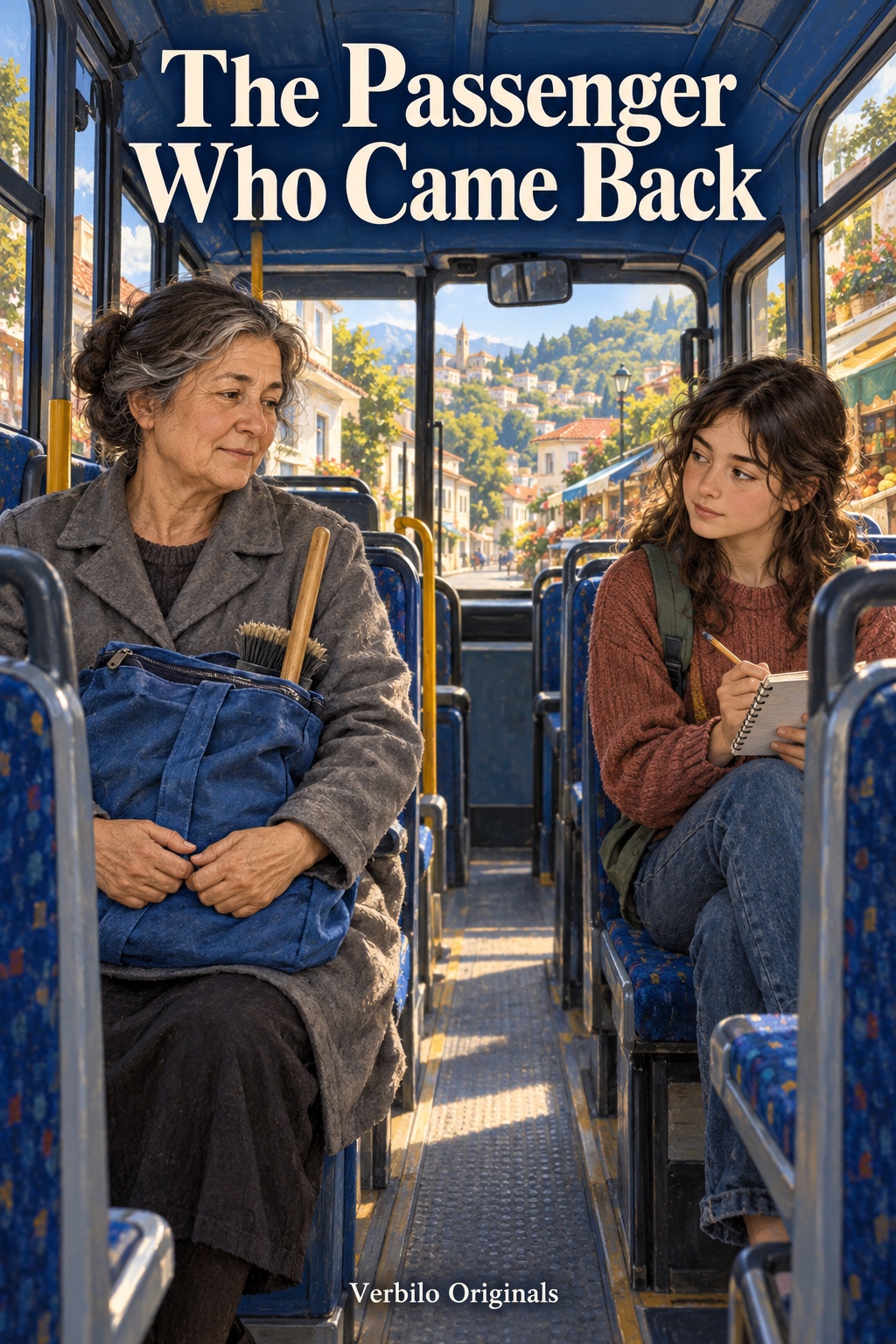
The woman with the blue bag got on the bus for the third time, and Esme put down her pencil. She was sure the woman had reached the market half an hour earlier. Now she was back at the bottom of the hill, holding the same bag against her coat. "Does this one count too?" the woman asked. Dan, the driver, nodded towards Esme. "Ask our passenger counter." Esme made another mark on her sheet. She did not look up until the woman had chosen a seat.
Esme was spending her school holiday helping at the bus office. For two weeks, the small blue bus was trying a new route around Cedar Hill. It went past the market, up to the library, along the high street and back down through the housing estate. The office wanted to know how many journeys people made. Esme had expected a busy notebook and a quiet morning. Instead, she had begun to recognise almost everyone who boarded.
There was the man with a folded newspaper, who got off at the library. There were two children and their father, travelling to the swimming pool. Most people made one journey and left. The woman with the blue bag had first boarded below the market. On the next circuit, Esme had seen her at the library stop. And now she was below the market again. She always used a day ticket. She always sat near the back.
Esme watched her through the window's reflection. The bag looked heavier than before. A long, narrow object pressed against its side, but Esme could not tell what it was. The woman wore ordinary shoes and a grey coat with a missing button. When the bus stopped outside the library, she got off without looking at the building. She turned towards a narrow street beside it. Esme added small question marks beside all three journeys.
At the end of the circuit, Dan parked for his break. "You keep watching her," he said. "Is she helping us get a higher number?" Esme asked. Dan took the lid off his cup of tea. "Has she told you that?" "No. But she keeps coming back." He looked at the empty seats behind them. "So do I." Esme waited for him to explain, but he only smiled and drank his tea.
A Door Without a Sign
At noon, Esme took her lunch to the library stop. She could see the little street the woman had used. Halfway along it stood a shop with no sign above the window. Its shutters were down, although the other shops were open. The woman was outside, pulling the door shut. Something bright caught the light in her hand. A key, Esme thought. Then the woman put it in her coat pocket and walked towards the stop.
They sat at opposite ends of the bench. The woman unwrapped a sandwich, and Esme opened her notebook. She had already written a question on a fresh page: Are some journeys being made only for the survey? She covered it with her hand. "You were on our bus this morning," she said. "I was." "More than once." "Yes." The woman took a small bite and waited. Esme had planned several questions, but none of them sounded as polite out loud.
"Do you live near the market?" she asked instead. "Not quite. Why?" "You went there, and then you were there again." "I go to lots of places more than once." A delivery van passed at the far end of the road. The woman wrapped the rest of her sandwich. "Are you taking the next bus?" "I'm having my break." "Enjoy it," the woman said. She picked up the blue bag to check the timetable beside the bench. Esme caught a clean, sharp smell as she passed.
Back at the office, Esme showed her morning sheet to the manager, Mr Kent. "Twenty-two journeys," he said. "That's more than yesterday." "But I only counted eleven different people." He turned the sheet towards him. "Did you miss anyone?" "No. Some people travelled several times." "Then they made several journeys." Esme pointed to her three question marks. "This woman may be trying to improve our results." Mr Kent stopped reading. "What makes you think that?"
Esme described the blue bag, the day ticket and the closed shop. "Perhaps she owns the shop," Mr Kent said. "Perhaps," Esme replied. "I couldn't see a name." He gave her the sheet back. "Keep the marks. If you want to ask why people travel, ask everyone the same question. And tell them they don't have to answer." Esme looked again at the sentence she had hidden on the bench. She crossed it out. Below it she wrote: What is the main reason for your journey today?
What Was in the Bag
That afternoon, Esme rode the next full circuit with Dan. This time she explained her question before asking it. The newspaper man was returning from the library. A young cook was going to an evening shift. A man carrying a small plant wanted to visit his sister. Two passengers preferred not to answer. Esme thanked them and left their reasons blank. She found herself listening for whole answers instead of waiting for a word she could put in a box.
At the library stop, the woman with the blue bag boarded again. A thin wooden handle now showed above the zip. "Does this one count?" she asked. "Yes," Esme said. "And may I ask what your journey is for? It's for the bus survey. You don't have to tell me." The woman sat down and looked at her. "I'm going to work." Esme glanced towards the closed shop. "Is your shop open in the afternoon?" "My shop?" The woman laughed once, quietly. "I clean it. It hasn't opened yet."
Her name was Mrs Rowe. She cleaned three places during the week: a bakery below the market, the empty shop beside the library and a small office near the high street. That morning, the shop owner had called her back. A shelf had been moved after she had finished, and it had left dust across the floor. She had been paid for the extra visit. "I was back at the bakery stop because I needed this," she said, lifting the wooden handle. It belonged to a brush.
"I left it there this morning. I was using their brush at the shop, but I need mine for the office." Mrs Rowe opened the bag a little wider. Inside were cloths, gloves and a bottle with a yellow lid. The sharp smell Esme had noticed came from that bottle. The bright thing outside the closed door had been a key after all. The woman carried other people's keys, not a shop of her own. Esme remembered the question marks on her sheet and felt her face grow warm.
"I thought you were riding round to make our numbers bigger," she said. Mrs Rowe closed the zip around the handle. For a moment she said nothing. Then she looked at the bus's front window. "I would choose a morning when my bag was lighter." Esme tried to smile, but the woman had not smiled. "I'm sorry," she said. "I should have asked." Mrs Rowe adjusted the bag on her knees. "You have now."
They climbed towards the high street. From the bus window, Esme could see the steps leading down to the market. "Wouldn't it be quicker to walk back that way?" she asked. "Going down, sometimes. Getting home with the bag is different. And I can't clean three places all at the same hour." Mrs Rowe rested her hand on the wooden handle. "I used to leave a brush at each place. One shop changed owners. One office moved. After that I started carrying my own."
The Return Journey
At the office, Esme found Mr Kent preparing a short report. "The new route seems useful for reaching the library," he said. Esme put her afternoon sheet beside his. "And for reaching work. Some journeys don't end at the big buildings." She explained Mrs Rowe's three jobs and the extra visit. Mr Kent read the notes, then looked at the morning sheet. "Shall we remove the question marks?" Esme took an eraser from her bag. The paper was thin, so she rubbed carefully.
They checked the figures together. There had been twenty-two morning journeys, made by eleven people. Both numbers stayed in the report. Esme added that one passenger had made three work-related journeys during the morning. She did not describe the missing coat button or list the cloths and gloves. Those details were not needed to explain the journeys. Mr Kent added the afternoon reasons that passengers had chosen to give. The report would go to the team planning the next trial.
"Will they keep the route?" Esme asked. "This is one day's record," he said. "We'll need the rest of the week, and the costs. But this helps us know what to ask next." Esme had wanted the sheet to prove something important. It had seemed exciting to discover a trick. Now she could see how easily she might have written one into the report. She packed her notebook without adding a final sentence about the woman.
On her way home, she waited for Dan's last circuit. Mrs Rowe was already at the stop, with the blue bag standing between her shoes. There was still a wooden handle above its zip. Esme sat beside her. "We counted all your journeys," she said. "Even the one for the brush." "Good," Mrs Rowe replied. Then she moved the bag closer to her leg, making room for Esme's school bag on the bench.
When the bus arrived, Mrs Rowe let Esme board first. Dan looked at the pencil behind her ear. "More counting?" "Going home," Esme said. She put her day ticket against the reader and found a seat near the back. Mrs Rowe sat across the aisle. As the bus turned down the hill, the brush handle tapped softly against the window. At the market stop, neither of them got off.