The Better View
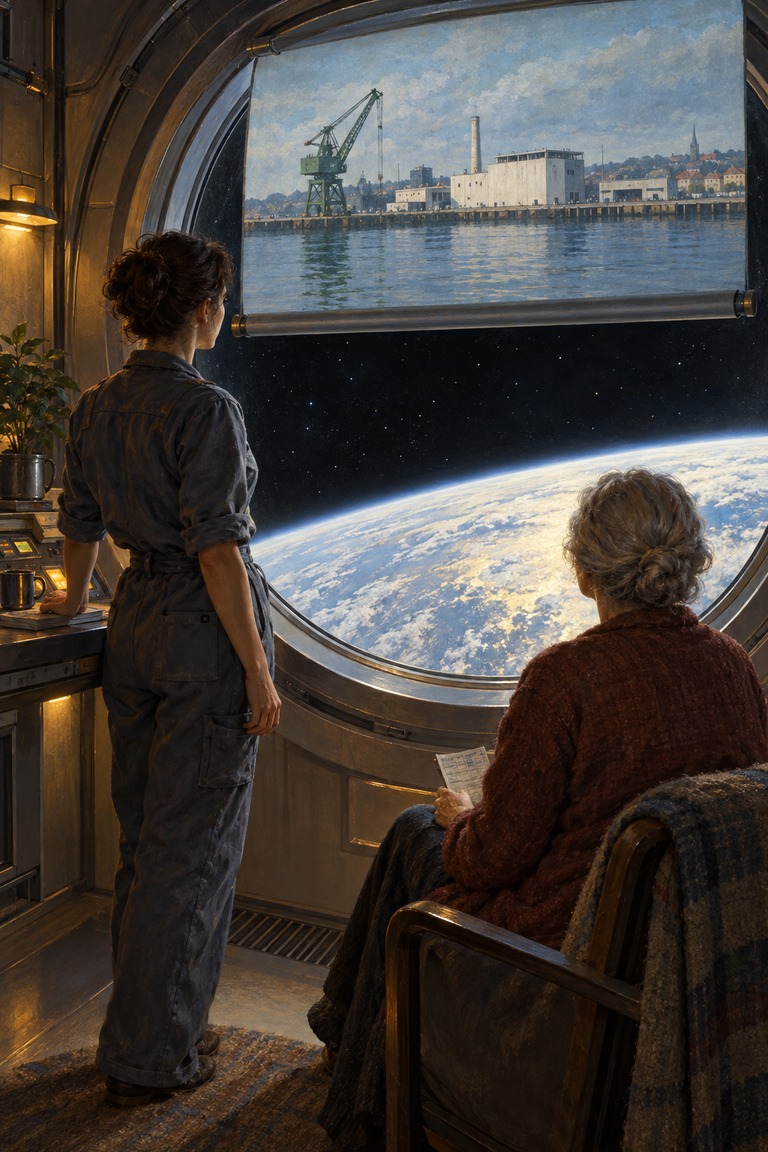
The first thing Iona removed from the harbour was a building that had not been there when Senn left. It stood between the green loading crane and the sea: a white, windowless block with a narrow chimney. The reconstruction labelled it an obstruction. Iona agreed, and the water flowed into the space it had occupied, taking the reflection of the crane with it. On the far side of the glass, no harbour existed. There was only the pale curve of the planet and a strip of black sky that the station's slow rotation would bring past the observation port.
The distinction was easy to explain in a manual. A retractable film covered the inner face of the port, turning it into a screen. Retract the film, and you saw the exterior through the sealed glass; extend it, and the room could face any landscape for which images were available. Iona's job was to make the second view feel as natural as the first. The company called it a window towards home. Late that afternoon, with the trial due to end at six, she was still adjusting the colours of a place she had never visited.
Daro came in carrying two cups and the list of remaining faults. He set a cup beside her console, where it would be within reach but outside the area marked for equipment. He had learned to make this small concession after she spilled coffee into a keyboard. The faults concerned the horizon, a cloud that repeated itself, and a gull whose shadow arrived before the bird. None mentioned the new building. Iona pointed it out in the source photograph. Daro studied the chimney, then the unbroken water on the screen. "Would anyone come all this way to sit and look at that?" he asked.
Senn arrived without the bag Iona had expected. Trial guests generally brought photographs, intending to improve the landscape before they had seen it. Senn brought a folded timetable. Her daughter had arranged the visit as a birthday present, and the booking described her as a former dockyard electrician, a description Iona had reduced to retired. The woman stood in the doorway for a moment, allowing the door to close behind her without stepping further into the room. Then she walked straight to the glass. "The crane is facing the wrong way," she said.
It was a useful fault. Iona reversed the crane's arm, saving the change under Senn's profile. In the photograph it had pointed inland; the reconstruction had turned it towards the water because that produced a cleaner outline. Senn watched the correction without sitting down. She glanced from the source photograph on Iona's console to the scene and asked where the white building had gone. Iona explained that the newest source image showed it but that the scene used a mixture of dates. "The building is still there, then?" Senn asked. Iona could not answer from the archive alone. The photograph was eleven months old. She offered to restore it. Senn said, "Give me a moment."
From her console Iona could see the woman's face reflected faintly over the harbour. She had prepared for gratitude, perhaps tears, and for the discreet withdrawal those would require. Instead, Senn was reading the reflection as though it were a diagram. She unfolded her timetable against the glass, then took it away before the paper touched. "Which direction is this room actually facing?" Iona indicated the real planet beyond the image. The harbour was on the hemisphere then hidden from them. "So even if this were today's picture," Senn said, "it would be a picture from somewhere else." Iona said yes, relieved to have a question she could answer without qualification.
The Part Outside
They sat beside the port while Iona restored the white block and corrected the cloud. The gull had been generated to supply movement where the archive contained none. She disabled it rather than attempt another adjustment. Without the bird, the harbour had the stillness of a photograph pretending to be patient. Senn asked when the tide would turn. There was no tide calculation in this version; the apparent movement of the water followed a loop. Iona showed her where the loop began. Senn nodded at the demonstration, and Iona began to suspect that the woman was being kinder to the machine than to herself.
"We can choose another time of day," Iona said. "Evening, if you prefer." Senn shook her head. "That building replaced the cold store. I wired the cold store twice. Once before they knew what they wanted, and once after." She traced the roof of the white block with a finger held just short of the glass. "My daughter says there's a training room in there now." Iona brought back the source photograph. The new building was not merely an intrusion between familiar objects. It was something Senn had been told about and had not yet seen. Removing it had taken away a possible question.
Daro returned to find the fault list longer. Iona had added a note about the mixed dates and another about the invented gull. He read them without comment, but his thumb held the corner of the sheet flat. "We need to distinguish faults from choices," he said. "A guest who wants a quiet harbour doesn't necessarily want a report on how it was assembled." Senn asked whether the room could show the exterior. Daro looked at Iona before answering. "The glass can. The installation is designed to make you forget the glass." He did not say it defensively. To him it was the clearest account of what they had made.
Iona retracted the film. The harbour disappeared upwards, revealing the black sky from the bottom first, as though the sea were being drained. The real planet occupied less of the port than Senn seemed to have expected. Its light was uneven. A wide area of cloud hid any detail they might have recognized, and the room's reflected lamps spoiled the darkness. Iona lowered the lamps, leaving a small light by the door. The change exposed a scratch in the inner glass which the projected water had concealed. Senn pulled her chair closer. "Does the station turn?" she asked. Iona explained which edge of the port the planet would leave.
Daro waited until Senn had turned towards the view. "A room with an ordinary observation port," he said quietly to Iona, "doesn't need this equipment or your work." She understood the objection. The project would supply rooms on vessels whose cabins had no ports at all. The demonstration room had a real one precisely so clients could compare. Giving the guest the exterior might appear to prove that the installation failed whenever it had something real to compete with. Iona could also see the competing claim: that she was about to dismiss a preference because it was inconvenient for the product. Neither thought helped her decide what to put on the sheet.
Senn asked for the lamps to stay low until a quarter past seven. Her daughter was piloting a cargo tug past the station before docking on the far side. The timetable gave the expected approach as five past seven, not a promise that the tug would be visible from this room. It might appear as a point of light if it passed within their angle of view. "She told me not to expect much," Senn said. "She's only bringing containers." The trial ended at six. At six fifteen the room was reserved for a visiting purchasing team. Iona looked at the timetable, then at the two cold cups. Senn folded the paper again, carefully along the same creases.
What the Screen Could Supply
The obvious accommodation was to put the tug into the harbour scene. Iona could have done it in minutes: a vessel passing beyond the crane, an approach light bright enough to be seen without effort, the time of its passage tied to the timetable. She had not proposed this when Daro did. Senn listened without interrupting, her hands resting on the folded paper. "Would it be her tug?" she asked. He explained that it would be an accurate representation of the vessel, using the company's available model. "And if she were late?" Daro paused. The generated tug would arrive on time unless somebody changed the schedule.
"We could let you move it yourself," he said. "Or wait for a message and then start it." Senn rubbed the fold in the timetable with her thumb. "I don't want to be responsible for getting her here." For an instant Iona heard a fear of responsibility rather than a refusal of control. Then Senn added, "She used to make me launch her toy boat. She'd stand at the other end of the bath and complain that I hadn't given it enough of a push." She smiled at the memory, but she did not look towards the blank screen. Daro's offer was considerate. It also gave her a job she had not asked to do.
When Senn went out to call her daughter, Iona opened the exterior settings. The film could remain retracted during the trial, but the demonstration programme extended it automatically after thirty minutes. That setting kept visitors from walking away with the impression of a dark, unfinished display. It had been her suggestion. She disabled the automatic return for the present session and entered the change in the log. Daro watched. "You'll have to explain why the sequence isn't complete." Iona said she would. She was less certain how to explain that completing it might erase the part of the demonstration that had finally interested the guest.
Senn came back with an update: the tug was delayed by twenty minutes. She did not ask them to extend the booking. She asked whether there was a public place with a view in the same direction. There was a small lounge on the next deck, but its port faced along the station's side, away from the approach route. The larger viewing room was closed for maintenance. Iona offered to check whether its work had finished early. Senn thanked her and remained standing. Her willingness to accept another room made it harder to treat the request as an unreasonable attachment to this one.
In the corridor, Daro asked whether Iona wanted him to cancel the purchasing team's visit. His tone was practical enough to make a yes sound possible. She did want it, and she could see that saying yes would leave him to defend the delay. She asked instead whether the comparison needed the whole hour. Daro said the team had requested a complete demonstration, including the change from exterior to reconstruction. "We can show them the exterior first," Iona said. "With the guest still in it?" She had not considered that part. She returned to Senn and described the visit, the number of people and the fact that they would be discussing the room. Senn said she would rather leave.
Iona found a second slot at seven thirty, five minutes after the tug's revised approach. It required Daro to move his review meeting, and the purchasing team to wait on the station longer. He called the team from the corridor. Iona stayed beside Senn, who had picked up the empty cups and was looking for somewhere to put them. The team agreed to the later time. Daro's meeting could wait until the following morning. When he came back, he crossed out six fifteen on the reservation sheet and wrote seven thirty, extending Senn's booking to fill the gap. "Nobody will thank you for the meeting tomorrow," he told Iona. His complaint was small enough that she could thank him for it.
An Unfinished Arrival
They had more than an hour left. Senn asked to see the harbour once again, this time with the lamps raised and the source date visible. Iona extended the film and restored the light. There was the new white block, the crane pointing inland, the invented gull gone from the sky. She had left the water moving. Senn asked to stop that too. The scene became an image that admitted it had been taken at a particular time. The date occupied a modest corner. Eleven months was neither yesterday nor the distant past, and Iona had no current view with which to replace it.
"My daughter would like this," Senn said. "She left before that building went up." She asked whether the picture could be sent to the tug after it docked. Iona checked the source's sharing permission and saved a copy without the reconstruction layer. Senn dictated a short note: "The crane still points the way you remember. The place behind it has changed." Iona let her read it before sending it to the address she provided. When Senn asked to return to the exterior, Iona did not save a general preference under her name. She changed the current session. Tomorrow, or in another room, the woman might want something else.
Daro brought fresh tea and asked which notes were still necessary. Iona retained the note about mixed dates and deleted the repeated cloud from the fault list, since the repetition had been corrected. The gull remained as a description of a removed feature. She added the disabled automatic return, specifying that it was a session setting, and recorded the rearranged booking. The entry about the new building required more care. Calling its removal a fault would imply that every guest must see it. Calling it a choice would imply that the guest had made the choice. She wrote that the reconstruction had omitted a structure present in the latest source, and that this omission had been reversed during the trial.
Daro read the sentence twice. "Will that help anyone make the next room?" Iona showed him the controls. The archive date was now displayed before the reconstruction began; an exterior view, where a port existed, could be selected without the automatic return. They could still supply the harbour without the building, or with an evening sky, but the screen would show which changes had been made. He tried the controls himself. The plain source image looked less impressive than the scene with moving water. He left it visible long enough to compare the roofs, then lowered the lamps and restored the exterior for Senn. "Keep the moving water for the demonstration," he said. "Just show them where it comes from."
At seven thirty, the purchasing team found the three of them looking into a dark port. The revised arrival time had passed. No point of light had crossed the part of the sky visible from the room. Senn's daughter had sent a message saying that she had reached the docking queue; she could not say whether the tug had passed their window. Iona offered Senn the use of the room until the message was answered. "She's busy," Senn said. "And I have seen what you said I might see." Iona began to apologize, thinking the sentence meant that Senn had come expecting nothing and received it. Senn pointed out the pale planet at the edge of the glass, almost gone now as the station turned.
The visitors waited by the door while Daro asked Senn whether she wanted to stay for their demonstration. This time she said yes. She moved her chair back far enough to leave them room at the console. Iona raised the lamps and extended the film. The harbour returned, with its white building and a visible date; she showed how the water's motion could be added, and how it could be stopped. Senn watched the roofs brighten in the artificial evening. Her timetable remained folded on her knee. When the first visitor asked whether the room could keep that view all night, she reached for her tea, leaving the answer to Iona.