An Empty Hall
At five o'clock, Lila opened the village hall and stopped at the door. The long tables were there. The cups were there. But the chairs were gone. She looked behind the curtains. She looked in the kitchen. Then she counted the chairs again. There was only one, in a dark corner near the stairs. One chair for thirty people. Her first evening in charge of the hall was not going well.
The village dinner started at seven. Lila's uncle usually opened the hall, but he was away. That morning, he gave her the key and a short list. Open the windows. Put out the chairs. Help Mrs Bell with the food. Lila wanted a harder job. Now she wished that her uncle's list said where to find twenty-nine missing chairs.
She went to the chair in the corner. Its front leg was shorter than the others. When she touched its back, it moved from side to side. "You can't even stand still," she said. "You'd move too, with a leg like mine," the chair replied. Lila took her hand away. For a moment, she could only hear the hall clock. "Did you say that?" she asked. "Of course. There's nobody else here."
The chair's voice was low. "Where are the other chairs?" Lila asked. "On the hill." "Why?" "To see the evening sky. I've never seen it myself. We hear people talking about it after dinner." Outside, a branch tapped the window. Lila looked at the chair's short leg. "And they left you here?" "I told them to go. I can't walk that far."
Four Legs and Two Wheels
Lila sat on the floor beside the chair. "They must come back. We have a dinner tonight." "I know," said the chair. "You could tell them." "Will they listen to me?" "They listen when someone sits on them. People do most of their talking then." Lila almost smiled. She could carry one chair, but not twenty-nine. She needed them to walk home. First, she needed to reach the hill.
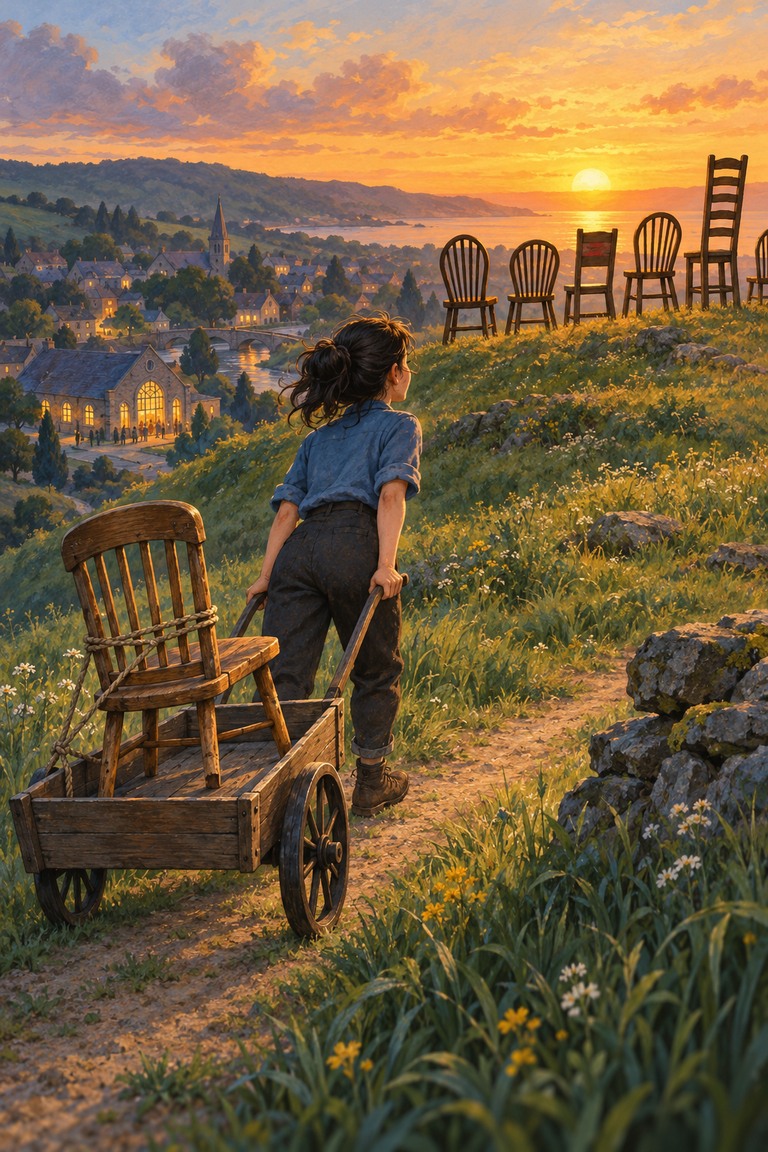
Behind the kitchen was a small cart. Mrs Bell used it to bring heavy boxes from her car. Lila pulled it into the hall and put the chair on it. "What are you doing?" the chair asked. "Taking you with me." Its wooden back pressed against her arm. "But I can't help you carry the others." "I know. Hold still." She tied it to the cart with a piece of rope. This time, all four legs were off the floor.
The road to the hill went past Mrs Bell's house. She was standing at her door with two pots of soup. "Where are you going with that?" she asked. Lila opened her mouth. The chair stayed quiet. "The chairs are on the hill," Lila said. "I'm bringing them back." Mrs Bell looked at the rope and the cart. Then she looked at Lila. "The soup can wait until seven. Come and tell me if you need help."
The cart's wheels were small. On the road, they turned easily. On the hill path, they hit stones. Lila stopped twice to lift a wheel over a large stone. Soon her arms hurt. "We could go back," said the chair. Lila looked up. Against the pale sky, she could see a long row of wooden backs. "We're close now," she said. She pulled the cart again. This time the chair leaned forward with her.
A Row in the Grass
At the top of the hill, twenty-nine chairs stood in the grass. They faced the wide valley. Lila knew them all. There was the chair with a red mark, the chair with a round back, and the two tall chairs from beside the piano. Their legs were still. Beyond them, the sky was changing from blue to yellow. Lila brought the cart to the end of the row. "You made it," said the chair with the red mark.
Lila untied the rope and lifted the short-legged chair onto the grass. It moved to one side. She placed a flat stone under its short leg. Now its back was straight. Nobody spoke. The chair watched the yellow light on the valley. Lila sat on it carefully. Its seat was warm from the sun. She could feel her own heart slowing down. Down in the village, the hall's windows were bright.
"We need to leave soon," she said. The two tall chairs moved their backs. "Soon isn't now," one said. "We want to see the sun go behind the hills." Lila looked at her watch. It was six fifteen. The walk down would take about twenty minutes. Putting thirty chairs around the tables would take more time. "Then I won't be ready for dinner," she said. "We've been ready for every dinner," said the red-marked chair.
Lila looked across the row. She spent the morning thinking about her key and her important job. Now she had twenty-nine chairs waiting for the sun and thirty people coming for soup. "I can bring you back," she said. "But I need your help at the tables. You know your places." The chairs looked at one another. Some of the chairs turned a little towards the path. "After the sun goes," said the red-marked chair. Lila nodded and stayed on the warm seat.
Soup at Seven
The sun disappeared at six thirty. The valley turned grey, but a thin line of orange stayed above the distant hills. Lila waited while the short-legged chair took one last look. Then she lifted it onto the cart and tied the rope again. The other chairs stepped onto the path. Their wooden feet made small, uneven sounds. Lila walked behind them with both hands on the cart. Going down, she had to stop it from moving too fast.
They reached the hall at ten to seven. The first guests were already at the door. Mrs Bell stood beside them. Before Lila could explain, the chairs went through the door in a long line. The guests stepped back. Inside, each chair found a place at a table. The two tall ones stood at the ends. The red-marked chair moved close to the window. Lila put the short-legged chair on the floor and watched it rock again. The flat stone was still on the hill.
Mrs Bell went into the kitchen and came back with a small piece of wood. She put it under the short leg. Lila pressed the seat. It stood still. "A good place," said Mrs Bell. "I can see the whole room from here." She sat down. Someone opened the soup pots. People began passing cups and bread across the tables. Lila looked at the clock. Seven o'clock. She took the empty place beside Mrs Bell.
After dinner, Mrs Bell carried the pots into the kitchen. "Thank you for the trip," the chair said quietly. Lila brushed a little grass from its seat. "Did you like the sky?" "Yes. But the soup smelled good too." She laughed. Later, she found her uncle's list and added one line at the bottom. Take the cart when the chairs go out. Then she left the short-legged chair beside the window, with the wood still under its leg.