Nothing Elaborate
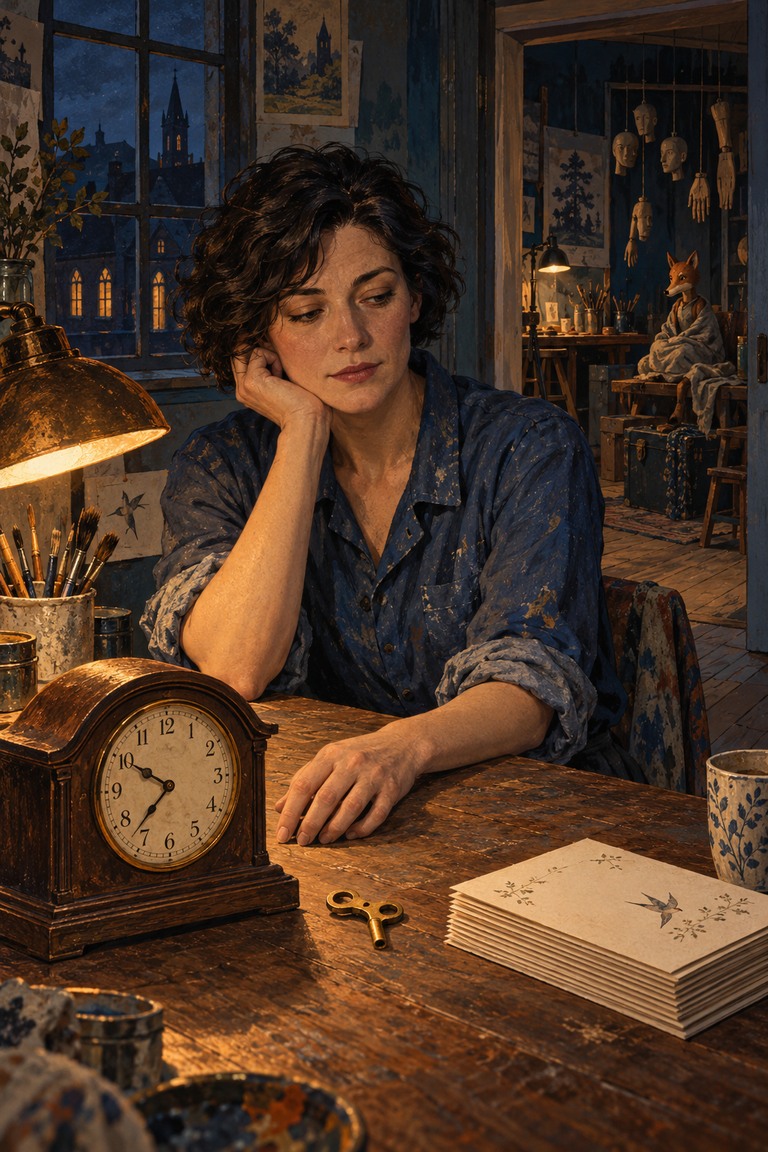
By six o'clock, I had written Iris's reply to a request I had not yet made. The reply lay beneath the breadboard, where Helen was unlikely to find it unless she needed the board. I had placed the loaf on a separate plate. This seemed a reasonable precaution rather than an admission of anything.
Iris and her partner, Sam, were coming at seven. We had not seen them since I left the consultancy in February, although left was the word I used and not quite the word Helen used. In the invitation I had promised nothing elaborate: a meal, a bottle of wine, a chance to catch up. Helen had interpreted that as permission to make soup. I had bought duck, rearranged the dining room and borrowed four chairs from the neighbour because our ordinary chairs looked, to me, like chairs belonging to people who ate in the kitchen.
We did eat in the kitchen. There was nothing wrong with this. I had explained that twice. Helen came home from her afternoon shift carrying a paper bag of mushrooms. She worked at the cinema, where she had recently been given responsibility for programming the Sunday films. I knew this, but had somehow continued to describe her job as temporary. The bag smelled of damp woodland. She set it beside my polished glasses and looked at the table. "Are we expecting anyone else?" "Just Iris and Sam." "Then why have you put the chairs so far apart?" I said something about giving people room. She moved them closer. The room no longer looked as if we were about to take opposing positions on a motion. I could not decide whether this was an improvement.
The document under the breadboard was a reference for a position at another consultancy. The application form asked whether they could contact my former manager. Iris had been my manager for eleven years. She had put me on projects nobody else wanted, defended my budgets and, on one memorable occasion, told a room full of clients that a mistake I had made was a mistake we had made. For months I had wondered what she had said about me in my absence; that she might have had other, more pressing subjects to discuss had occurred to me only as a possibility to be dismissed.
The employer wanted an answer by midnight. I had received the form four days earlier, but told myself a request made face to face would be more considerate than an email. An email would oblige Iris to compose something, whereas a draft, framed as an optional convenience, would leave her free to change whatever she disliked. It had taken considerable ingenuity to make my preferred answer look provisional.
"How much soup?" Helen asked. "A little, perhaps. There's the duck." "You bought a duck?" "I thought it would be nice." She checked the oven, then my watch, as if the two might disagree about what was possible. She said the soup would keep. I offered to chop the mushrooms, but she had already taken out a knife.
At a quarter to seven, Iris sent a message: Running a little late. Please don't wait for us to eat. I answered, No hurry at all, then adjusted the oven. I had planned to raise the application casually between the main course and dessert. There would be no particular moment at which a social evening became something else.
Helen watched me lay four identical napkins on four identical plates. "If you need to ask her about work, ask her." "It's hardly about work." "What is it about, then?" I straightened the napkin nearest me. "Knowing where we stand." She did not ask who we meant. She went back to the kitchen, and I put a fifth napkin over the edge of the breadboard, just enough to hide the paper showing beneath it.
A Perfectly Ordinary Evening
They arrived at twenty past seven, carrying a small flowering plant in a pot that had leaked into the gift bag. Sam apologised for the traffic. Iris apologised for the plant. They had bought it outside the station and had been assured, she said, that neglect would suit it better than attention.
"Then it's come to the right place," Helen said, and took it to the kitchen windowsill. Sam laughed. Iris did too, after a moment in which I could see her deciding whether this was a joke about Helen, about me, or simply about a plant. At work she had been swift and definite. I remembered a woman who could turn a discussion into a decision by closing a notebook. Tonight she looked at each room as though it contained something that might require permission.
I took their coats. Iris asked for water. I poured wine for Sam and myself, then, forgetting her request, put a third wineglass in front of her. She moved it aside without comment. "Water," Helen said from the doorway. "Of course." "Still, please," Iris added. She had supplied a detail I could act on, and I was absurdly grateful. I brought the water and asked about the office.
"I'm not there now," she said. Sam examined the label on the wine bottle. Helen put down the fourth glass. "Since when?" I asked. "Three weeks."
I tried to remember which of my recent messages she had answered. There had been one about a new contract, another about an article naming our former firm, and the dinner invitation. She had replied to the invitation with an exclamation mark. I had taken this as evidence that matters were amicable, as if punctuation could attest to a state of affairs about which I had been circumspect enough not to enquire. "A better offer?" "No." The word was neither bitter nor particularly inviting. I smiled in the way I used to smile when a client had left out an important figure. "Taking some time, then." "At the moment." Helen asked whether she would like to see the plant settled in its new home. They went into the kitchen. Sam settled onto one of the borrowed chairs, holding his glass by the stem with both hands.
I asked what he was working on. He restored furniture and had made a narrow bookcase for our old flat. He said he was repairing six dining chairs for a school. I said it must be satisfying to make something real. He looked at the borrowed chairs behind me. "Mostly I take things apart." "Yes, but at the end there's something to show for it." "Sometimes."
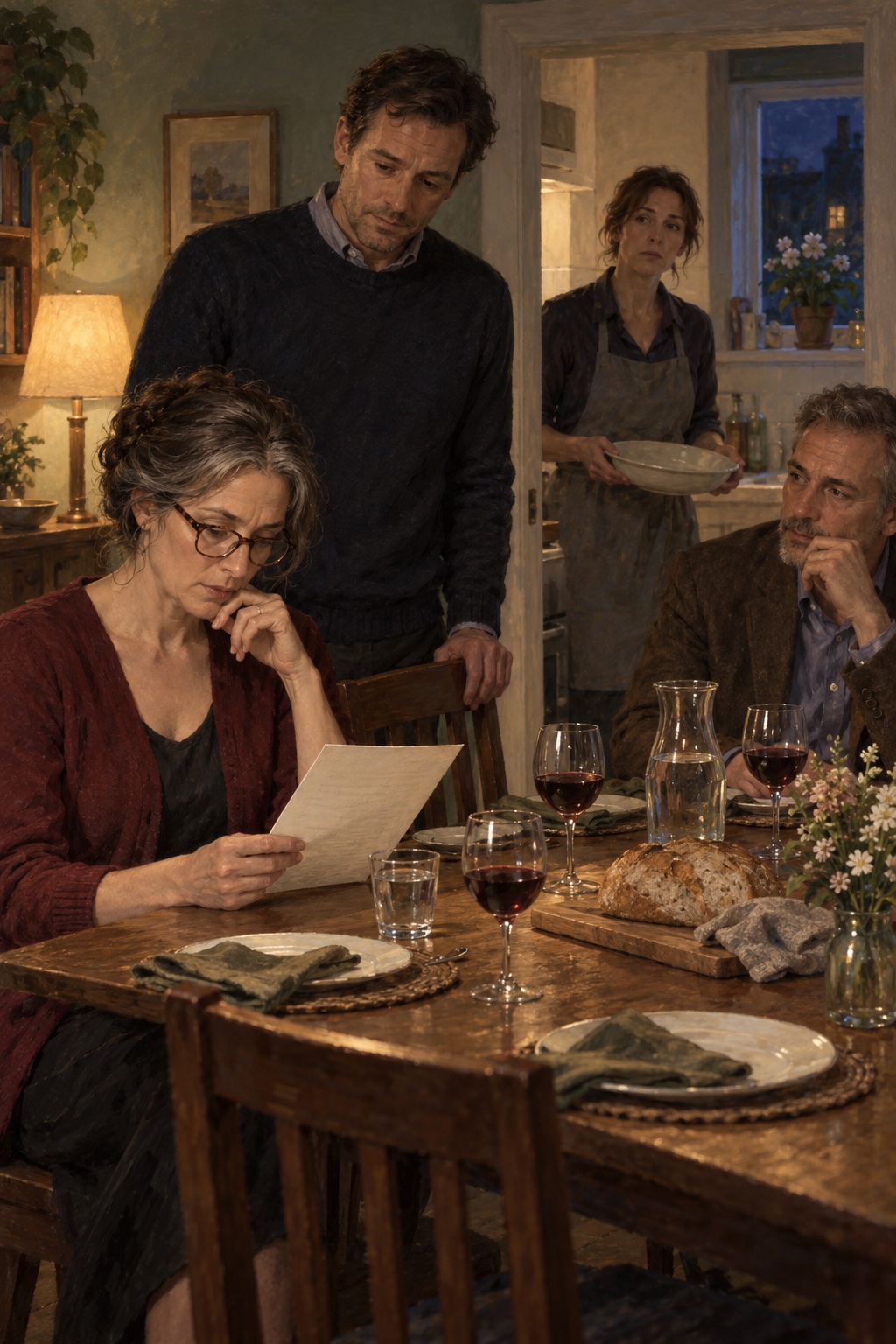
I could not decide whether he was resisting a compliment or correcting it. I asked about the school instead. He explained that the chairs had survived for forty years because they had been repaired, not because they were especially well made. I asked if that made his work easier. "Harder. You have to find out what the last person was trying to do." From the kitchen came a short burst of laughter. I recognised Helen's laugh, but not the remark that had produced it. This struck me as an omission in an evening I had organised. When they came back, Iris was carrying the bread. Helen asked her to fetch the board from the dining table. "There's another one in the kitchen," I said, too quickly. I reached for the board, but Iris was already beside the table. She set the bread down, folded back the napkin and lifted the board. My page was underneath it, face up. Before I could retrieve it, she had seen her own name at the bottom.
It was not a signature. I had typed her name beneath a sentence that began I can recommend Leo without reservation. There was room for a signature above it. "I was going to mention that later," I said. Iris held the page without reading further. "Would you like to mention it now?"
Without Reservation
I took the document from her, then realised that taking it back made the discovery look worse. I put it on the table between us. Helen stayed by the kitchen door. Sam did not move from his chair. "It's just a starting point," I said. "So you wouldn't have to do the tedious part." "Which part is that?" "Finding the wording." Iris sat down. She put on the glasses she had once worn only for contract appendices and began to read. I remained standing beside her, a position from which I could see the paper but not her face. Helen pulled out my chair.
The draft described me as the principal architect of a regional programme. I had helped design a reporting system for one part of it. Principal architect was a phrase elastic enough to accommodate the contribution I had made while directing attention towards the enterprise that contained it. The ambiguity struck me, when I was typing, as a legitimate economy of expression. As she read, it looked more like a means of appropriating work I could not have done. Iris put a finger beside the phrase. "You worked on the reporting system." "Which the whole programme depended on." "It depended on several things." "Of course. It's a reference, not a history." Her finger stayed where it was. I heard the sentence again, now that someone else had heard it, and wished I had said something about brevity.
Helen went into the kitchen. A cupboard closed more firmly than was necessary. Sam asked whether Iris wanted more water. She said yes. He brought the jug to the table instead of refilling her glass for her. There were other discrepancies. I had written that I managed a team of eighteen; Iris reminded me that four people reported to me and the others belonged to three different teams. I said I had coordinated them. She said coordinated would be a useful word. I had written that I delivered the programme on schedule. The reporting system had been finished on schedule. The programme had not.
I knew all this. What troubled me was not that she remembered the details, but that she treated them as details that mattered. I had imagined that our shared history would entitle me to a degree of latitude unavailable to an unfamiliar referee, with discretion compensating for whatever the record could not quite support. Instead, the more precisely she remembered my work, the less room she had to endorse my approximation of it. "You don't have to use it," I said. "What do you need from me tonight?" I explained the deadline, the form, the new firm. I said the job was almost the same as my old one. It was not: the new role involved managing several teams, not just a reporting system and its four people. I had decided I could learn that distinction after being appointed. "They only want permission to contact me?" Iris asked. "For now."
She took off her glasses. "Then why have you written my answer?" I could have said because I was frightened of the answer she might write. Instead I said I was trying to make things easy. Helen returned with an empty serving dish. "For whom?" There was no accusation in her tone; a defence would have had to introduce the charge it was meant to rebut. I looked at the serving dish instead. Iris turned the page face down. She said she could describe the reporting system, the problems I had solved and the four people whose work I had coordinated. She would not describe a larger job in order to help me acquire a larger job. Then she stopped talking. She did not offer an encouraging conclusion, and I was left waiting for one as though she had omitted an item from an agenda.
"You recommended me before," I said. "I did." "Without all these qualifications." "You hadn't written that recommendation for me." Sam shifted his chair. One of its feet made a small scraping sound. Helen asked him to check the duck, since he was nearest the kitchen. He stood, grateful, I thought, to be given a task with an answer.
I lowered my voice. "If there's something else you want to say about how I left—" "I don't," Iris said. "But there is something I haven't told you. I didn't choose to leave either." I looked at the face-down page. I had spent three weeks sending her scraps of news from a place that had just dismissed her. She had answered the dinner invitation. "Why didn't you say?" "I wasn't asking you for anything."
What Could Be Served
Sam came back without the serving dish. The duck was cooked, he said, but ought to rest. Helen followed him to the kitchen. Iris and I sat with the document between us. Until then I had regarded her departure as a complication in my arrangements. Now I tried to imagine the morning on which somebody had given her the news, and found I had no image of her at all outside an office in which she was in charge. "I'm sorry," I said. "I know." "I should have asked how you were." "You did ask. You suggested the answers as well."
A better offer. Taking some time. The questions had allowed her to confirm that nothing had happened which might alter what I could expect from her. Had she contradicted me, I could have mistaken the contradiction for a misunderstanding and gone on explaining. Her refusal to elaborate left me with the less congenial task of listening to the questions I had actually asked. She was looking at the glass of water, and I left my explanation where it was. Iris said she had not announced her departure widely because she could not face another conversation about possibilities. Everybody had a contact, a venture, a person who would be delighted to hear from her. Sam, she said, had stopped proposing things after the first week. From the kitchen he called that he had stopped on the fourth day. She smiled, and the correction belonged to a kind of intimacy I had mistaken for unhelpfulness.
I said I had been putting off the form because it would mean applying for a job I could fail to get. Preparing for dinner had been easier. I could buy the right food and arrange the chairs. Iris looked towards the doorway, where Helen had appeared with a bowl and a wooden spoon. "The chairs are terrible," Helen said. "You should sit on one before borrowing it." I laughed. It was an untidy laugh, too loud for the small remark. Nobody seemed to require me to improve it.
Helen told us the soup was ready. I asked about the duck. She said it would last until tomorrow, but she did not intend to carve it now. I understood that she was offering us a meal and refusing the programme I had attached to it. I began to say I had thought everybody would prefer the duck, then heard the familiar invitation to agree with me. "Soup would be good," I said. She gave me the bowl. "Then bring this."
I carried it to the table. Sam fetched spoons. Iris cut the bread. There was no toast, although I had prepared one, and no announcement that we were beginning again. We had moved the chairs close enough for Sam to pass the butter without standing up. Helen asked Iris whether she wanted to come to a film on Sunday. When Iris hesitated, Helen gave her the time and said she could decide on the day. She did not describe the evening as something Iris needed.
Before dessert I asked whether I could name Iris on the form. I told her she could refuse, then resisted adding that it would take her very little time. "Yes," she said. "If they ask, I'll tell them what I know." That was an answer I had not written. It left some things unsettled, including whether the employer would want me. I went to the kitchen, opened the laptop and filled in the form. Where it asked about my previous responsibilities, I put reporting system and a team of four. I sent it without returning to the table to have the wording approved.
Helen was dividing poached pears among four small plates when I came back. Sam had turned one of the borrowed chairs upside down and was showing Iris a repair in its underside. He asked whether I had anything to put beneath it so the tabletop wouldn't be scratched. The reference was still lying face down beside my place. I reached for it, paused, and fetched yesterday's newspaper from the kitchen instead. Sam spread the paper, set the chair on it and continued his explanation. Iris leaned forward to see. I took the unused draft off the table and went to find the fourth dessert spoon.