Three Notes After Dark
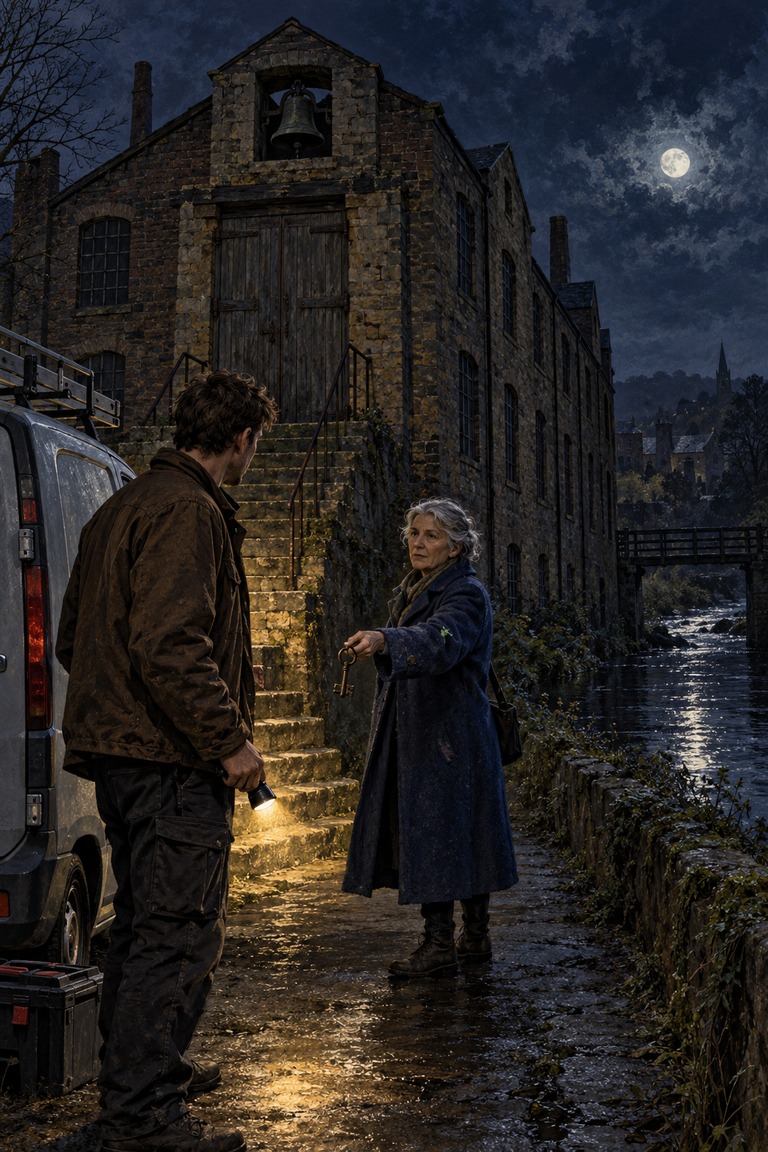
The bell rang three times while Cal was counting the windows of the empty mill. He lost his place at the seventh window. The sound was slow and heavy, nothing like the thin alarm on his van. Across the river, a dog began to bark. Then the building was quiet again. All twelve windows were dark. Cal looked at the time on his phone: nine o'clock, exactly when Ruth had said it would happen. He had expected to hear loose metal in the wind. There was hardly any wind.
Ruth came down the lane wearing her old blue coat. She stopped beside the van, breathing quickly. "You heard it?" she asked. Cal nodded. "And nobody went in?" He had watched the front door for twenty minutes, but he could not see the other side of the building from there. He said so. Ruth held out a large key. "There's only one door that still opens. I've kept this since the last shift." She did not hand it over immediately. He waited until she placed it in his palm.
The mill had made blankets for almost a century. Now the council was selling it, and Ruth had to return the key on Friday morning. She had asked Cal to investigate the bell before then. He repaired alarms and door systems, though this job seemed to involve neither. Ruth had suggested that somebody might be hiding inside. "If you find signs of that, they'll have to check the whole building," she said. "They can't just hand it to a buyer." Cal said his report would describe whatever he found. He could not promise a delay.
Cal used the key in the padlock while Ruth lit the steps with his torch. Inside, the air smelled of wet stone and old oil. Their footsteps travelled further than he expected. A square of pale dust lay beneath a broken shelf, untouched except for mouse tracks. The wooden stairs climbed into darkness. Ruth warned him that the upper landing was unsafe, so they stayed below it. She pointed towards the bell rope, which ended above Cal's head. Its lower half had been cut away.
"When did that happen?" he asked. Ruth said the council had shortened it after visitors kept pulling it. The bell itself hung beside a small opening near the roof, where workers once watched for delivery carts. Cal could see the iron frame but not the clapper inside the bell. Without a ladder he would get no closer. He asked whether the old machinery was connected to it. Ruth shook her head. "We rang it by hand. Three times at the end of the evening shift. You could hear it across the water."
Cal took photographs of the rope, the stairs and the floor. He checked the back wall from outside; the old loading doors had been sealed with boards. A damp path ran between that wall and the river. On it he found fresh boot marks leading towards the building and back. He photographed those too. Ruth stood at the corner, watching his torch move. "The rubbish truck comes here," she said. "Dean walks round to check the boards." Cal told her he would come back in daylight with a ladder. Before leaving, he gave her the key.
The Wrong Boots
On Thursday morning, the mill looked smaller. Cal could see that the roof opening stood directly above the sealed loading doors. A gutter ran along the roof above them, its lower pipe missing. He parked away from the muddy path and brought his ladder round the building. Ruth was waiting by the front door with two paper cups. She had written the words 'three strokes, nine each night' on a scrap of paper. Under that she had added 'inside the locked building'. Cal put the scrap beside his own notes without copying the second line.
Dean arrived to collect the rubbish outside. He had mud on his trousers and the kind of heavy boots Cal had seen in the prints. Ruth asked if he had been there the night before. "Not after five," Dean said. He looked from her to Cal. "Are we still talking about that bell?" He did not sound pleased. Cal explained that he was checking all possible ways of ringing it. Dean put down the empty bin he was carrying. "Then check the roof. Birds get in there. I don't go inside."
Cal asked to look at the soles of Dean's boots. Dean lifted one foot, holding the wall for balance. The pattern was made of thick, straight lines. The prints by the river had small circles around the heel. Cal showed him the photograph. Dean stared at it, then gave a short laugh. "That's a different pair." Ruth said the rain might have changed the marks. The clearest print lay under the roof's edge, however, where the mud was still soft and the circles were sharp. Cal thanked Dean and let him get back to work.
Ruth opened the mill. Cal set the ladder on the solid stone floor beneath the bell, well away from the damaged landing. From the top he could see that the clapper was still attached. A second, thinner wire ran from its arm through the roof opening. It disappeared behind the gutter outside. There was no electric motor, no timer and no connection to the stopped machines. Cal moved the clapper gently and heard one low note. Ruth stepped back as if it had surprised her. "That's the sound," she said.
He climbed down and followed the wire from outside. It ran behind the gutter and along the back wall, ending in a little metal ring near the river path. Someone had wrapped a strip of blue wool around the ring, keeping it from tapping against the stone. A green mark crossed the wool. The wire was rusty at the top but clean where its two lower pieces joined. Whatever its original purpose, somebody had repaired it recently. Cal did not pull the ring yet. He wanted a photograph of it in place.
Ruth said the wire must have belonged to the men who unloaded carts. Cal agreed that it could be old. The repair and the cloth were newer questions. He asked whether anybody else used the river path. She looked towards the wooden bridge beyond the mill. "People walk their dogs. Schoolchildren come through." On a fence post beside the ring, a fresh green sign said the bridge was closed. Ruth explained that it had been painted on Monday afternoon. Cal noticed a spot of the same colour on her sleeve, just below a small tear.
A Sound From Outside
Cal asked Ruth to wait by the front door. He stayed on the river path and pulled the metal ring once. The bell sounded above him. He pulled it twice more, leaving a pause between each note. Ruth came round the corner before the last sound had faded. For a moment neither spoke. The wire trembled against the blue cloth. Cal showed her that the front door could be locked and the building empty when the bell rang. His report would have to include that. A sound inside did not prove that a person was inside.
"Someone must be coming along this path," Ruth said. Cal asked if she knew who. She shook her head. He could write that an outside control existed, without naming an operator. That was what the evidence supported. Yet he was uneasy. Ruth had suggested Dean before he mentioned the boot pattern. Now she was looking at the wool rather than at the wire. Cal took out his photograph of the footprints. He did not ask her to lift a boot. "Did you come round here after dark?" he asked.
Ruth sat on a low stone beside the loading doors. She set her cup down carefully, though it was already empty. "The first evening, I only wanted to hear it," she said. Cal lowered his phone. The bridge sign had still been wet that night, and she had brushed her coat against the post while reaching for the ring. After the third stroke, the old wire had broken in her hand. She had joined it the next afternoon and wrapped the ring with cloth cut from the torn sleeve. After that, the bell could be heard from the lane again.
"Why ask me to find someone in the mill?" Cal said. Ruth looked at the sealed doors. "Because they aren't coming to look at it. They're coming to take the key." She had written to the council about the broken landing, the old machines and the workers' names scratched into a door upstairs. Her letters had received replies about sale dates. When two neighbours heard the bell, they asked if somebody was living inside. She let them think so. Then she called Cal, hoping his report would bring an inspection before Friday.
Cal could understand wanting someone to enter the building. He could not put an intruder in his report to make it happen. He said this more sharply than he intended. Ruth's head came up. "I didn't ask you to lie." He held out her scrap of paper. She read the second line and looked away. "No," she said after a while. "I wanted you to believe me." Water moved below the path, carrying a yellow leaf past their feet. Cal folded the scrap and put it back with his notes.
He remembered his first photographs. Ruth's warnings had kept him from approaching the upper door, but the damage was visible from below. He had photographed it only as the route he could not use. Now he looked again: part of the landing had dropped away from its support. The photograph showed that clearly. He asked if she would let him include her letters and dates with it. She nodded. The building's condition was a separate question from the bell. He could report both, provided he did not use one to hide the truth about the other.
Before the Key Changed Hands
Ruth picked up her empty cup, and they returned to the front office, where she kept copies of her letters in an old biscuit tin. Cal read the earliest date, then the latest reply. He photographed the pages with her permission and added them to his report. He described the visible damage without claiming to know what had caused it. He also described the outside wire and Ruth's account of ringing the bell. She asked to read that part. Cal turned the screen towards her. She corrected 'every night' to 'the last three nights'. He changed it before sending the report to the council.
Ruth asked whether he thought the sale would stop. Cal said he did not know. He could not decide whether the building was safe, and the bell did not answer that question. The council had to send someone qualified to assess the damage. Ruth rubbed the dark mark left by her cup on the desk. "I suppose you won't want payment," she said. He told her he had done the job she asked him to do. She took an envelope from the tin and counted out the agreed amount. He gave her a receipt.
Dean came back for the bin he had left by the wall. Ruth went out to meet him. Cal heard her tell him that she had rung the bell and should not have suggested he was responsible. Dean listened with both hands on the bin handle. "You could have asked me about the wire," he said. "I remember when the outside ring was used." He did not smile or offer to forget the accusation. Ruth said she was sorry. He carried the bin to his truck, and she watched until he had driven away.
On Friday morning, Cal received a call from the council. The key handover would still take place, but an inspector would attend and the upper floor would remain closed until it had been checked. Nobody mentioned cancelling the sale. Cal called Ruth and told her exactly what he had been told. "They're going upstairs?" she asked. He said they would decide how to inspect it. There was a short silence. "Then I'll bring the letters," she said. "And the names, if they want them." He offered to send another copy of the report if she needed it.
Cal drove past the mill later that morning. A council van stood by the front door. Ruth waited beside it with the biscuit tin under one arm. The person collecting the key pointed towards the roof opening. Cal could not hear the question through his closed window, but he saw Ruth point round the building. She led them along the river path. At the corner she stopped and held the tin out to the inspector, freeing a hand. Cal slowed the van. He wondered whether she would ring it three times again.
Ruth pulled the ring once. The note travelled across the water, and the inspector looked up towards the roof opening. She waited until he had found the bell. Then she took back her tin and followed him to the front door. Cal drove on before the key changed hands. That evening, at nine, he was fixing a door alarm on the other side of town. He checked the time when it sounded, then returned to work. The alarm needed a second adjustment. Its note was much too thin.