A Friend for Lunch
Clara had just put the second plate on the table when her mother rang. The stew was ready, the wine was open, and the blue serving dish stood at the centre of the table. In the old house, Clara's father had always put it there, within reach of everyone, although he invariably served himself last. He had been dead for four years. In Clara's new flat, the dish was the only thing that made the table look familiar. She moved it slightly to the left before answering. Her mother was downstairs, but she had not come alone. "Martin's with me," Helen said. "The friend I mentioned. Is that still all right?" Clara looked at the two plates. On Friday, when Helen had asked if she could bring a friend, Clara had said of course. Then she had planned the meal as though nothing had changed. She had pictured someone from her mother's evening class. Martin, she now remembered, had been mentioned in connection with a walk by the river. "Of course," she said again. "Come up."
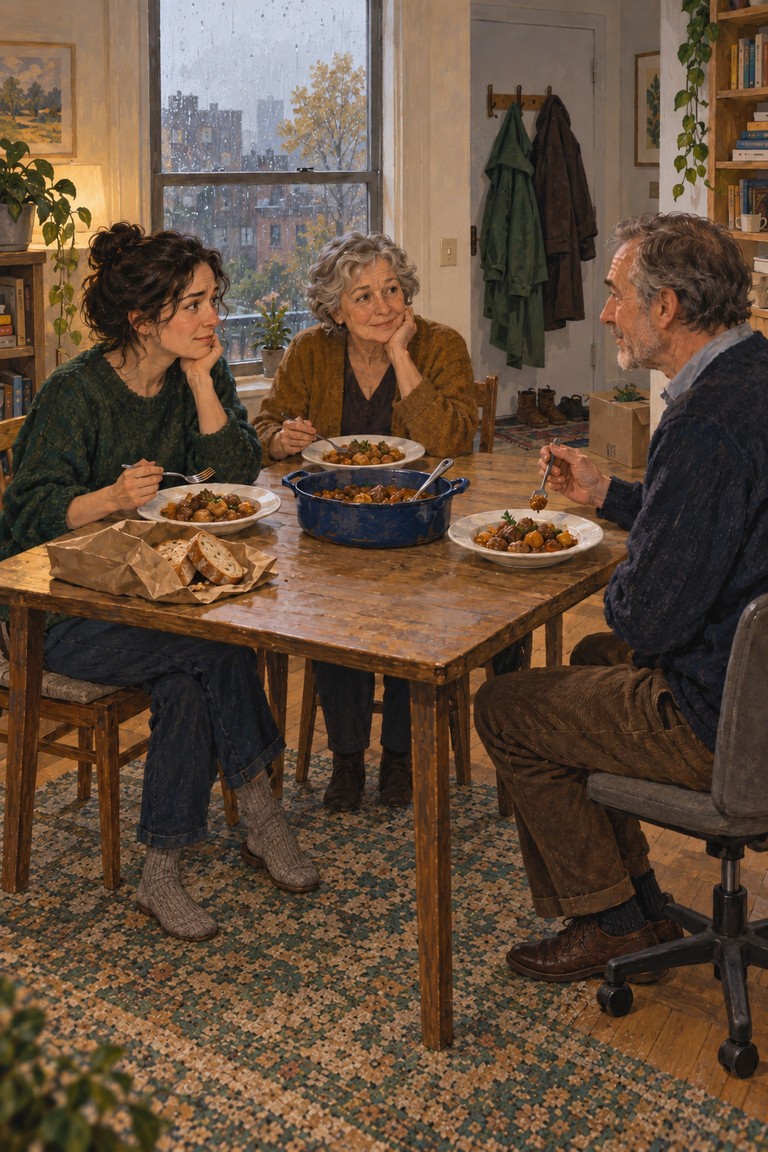
She fetched a third plate from the cupboard and pulled her desk chair into the dining area. Its wheels rolled over a corner of the rug. She straightened the rug, then the chair, then the plate. At the hotel where she worked, she could make almost any unexpected arrival appear to have been anticipated. She was still telling herself this when the doorbell sounded. Helen came in wearing the green coat she usually kept for special occasions. Behind her stood a man with a paper bag of bread. He was about Helen's age, with wet shoes and a small patch of rain on one shoulder. "We got caught between the bus stop and here," Helen said. She brushed a drop from his sleeve without looking at it. The movement was brief, ordinary and unmistakably practised.
Martin offered the bag to Clara. "Your mother said you were making lunch. I didn't want to arrive empty-handed." His voice had none of the excessive cheerfulness she had braced herself for. He waited while she found somewhere for the bread. Martin hung his coat by the door. Helen took off hers and hung it on the hook beside his, as if the two coats had come from the same house. Martin glanced towards the desk chair. "Shall I take that one?" Clara said yes before remembering that she had meant it for herself. He sat without testing whether it was less comfortable than the other chairs. Helen put her handbag beside her feet, and Clara went to get the stew.
In the kitchen she lifted the lid and watched the steam settle on the window. She had made lamb with onions and the small potatoes her father preferred, following the recipe Helen had dictated over the phone years ago. Clara seldom cooked it for herself. The invitation had been meant to mark the flat becoming a home: her mother would eat, stay for coffee, and perhaps help her decide where to put the books. There was no reason Helen should have known all this. Clara had written, "Lunch on Sunday? Come at one." She had left the rest inside her head. She spooned stew into the blue dish and carried it to the table, trying to remember whether Martin ate lamb. She could have asked while he was standing in the doorway. Instead, she had asked whether his journey had been easy, a question to which she already knew the answer.
"This smells lovely," Helen said. Clara served her first, then Martin. He thanked her and moved his glass so she could reach his plate. They discussed the rain, the unreliable lift and the view from the sitting-room window. Nothing in the conversation required Clara to acknowledge the touch on his sleeve. She asked about her mother's class, and Helen told her about a drawing that had gone wrong. "You liked it afterwards," Martin said. "You said the crooked roof made it look lived in." Helen laughed. Clara had heard the story of the crooked roof on the telephone, but not its ending. She looked down at her plate and cut a potato into four pieces. It was unsettling to discover that a familiar story had continued without her, and that someone else had been there to hear it.
What Had Not Been Said
Clara asked Martin how he knew her mother. It was a reasonable question, delivered in the tone she used when checking a guest's booking. Helen answered before he could. They had met at a film club the previous autumn; he had lent her a book about a director whose films she disliked, and she had returned it with several arguments written on a sheet of paper. "I thought lending the book would settle the matter," Martin said. "It made things worse." Clara smiled because a smile was expected. She was calculating how many months had passed since autumn. There had been birthday calls, ordinary calls, calls while she was walking home from work. Her mother had spoken of films and books, and Clara had asked whether she was sleeping properly, whether the house was warm, whether the garden needed attention. She had not asked who was discussing the films with her.
Helen took a piece of bread. "We're going to the cinema this afternoon," she said. "There's a showing at half past three." Clara looked at the clock. It was barely a quarter to two. "You didn't say you had plans." "I did mention the film on Friday." "You said you might see it." Helen paused. "We booked yesterday." Clara remained silent. She had intended to make coffee after lunch and had bought the cake Helen liked. She could still do both. She had imagined an afternoon in which her mother had nowhere else to be. Martin started to say something about the cinema being close, then stopped. He had recognised that distance was not the subject under discussion.
Clara reached for the serving spoon. "There's more, if anyone wants it." Helen said she had enough. Martin accepted a little, and for a moment the simple work of passing plates helped. Then Helen asked where Clara had found the blue dish. "You gave it to me when I moved," Clara said. "Did I? I remember packing so many things." "You said Dad would have wanted me to have it." Helen looked at the dish with an expression Clara could not read. "Yes. He liked to see things being used." Clara wanted more than that. She wanted the dish to summon a particular Sunday, the old table, the sound of her father pretending to argue about who had taken the last potato. She began telling Martin the potato story. Halfway through, she realised she was explaining why the three of them were not simply three people eating lunch.
Martin listened. When she finished, he said, "He sounds as though he enjoyed having people round." The remark was kind and modest, and Clara disliked it for being both. "He did," she said. "Mum hasn't had many people round since." Helen put down her fork. "You don't know everyone who comes to the house, Clara." "I didn't mean—" "I know what you meant." There was no anger in her mother's voice yet. She could have apologised. Instead, she asked Martin whether he had known her father. "No," he said. "I never met him." He did not add that he wished he had. Clara was grateful for that, although she could not have explained why.
She picked up her wineglass and set it down without drinking. "How long has this been going on?" Helen looked at her directly. "We've been seeing each other since February." February: eight months ago. Clara remembered a weekend when her mother had sounded unusually pleased on the telephone. She had assumed a friend had visited, or that the weather had improved. The assumptions seemed foolish now, yet she resented being required to replace them all at once. "You could have told me." "I should have told you clearly," Helen said. "I thought bringing Martin would make it easier. I can see that it hasn't." Martin folded his napkin once and left it beside his plate. He did not look at Helen for permission to speak. "Would it help if I gave you a few minutes?" he asked.
Clara wanted to ask him to leave, although he had done nothing she could reasonably complain about. Martin had not insulted her father or claimed his place. He had brought bread, eaten lunch and remembered the ending of a story. It was the ease between him and Helen that Clara could not accommodate. "There's a little balcony," she said. "Through the sitting room. I'll bring coffee in a minute." Martin nodded and stood. Helen remained at the table. From the kitchen doorway, Clara watched him slide the balcony door open and step under the shallow roof. He kept his hands in his pockets. He was outside, but the third plate was still on the table, with half a potato left on it.
An Afternoon of Her Own
Clara took the plates to the kitchen, and Helen followed carrying the blue dish. Neither wanted to begin the conversation seated. Helen set the dish on the draining board. Clara scraped the remaining stew into a container and turned towards the sink. "I thought you were coming to see me." "I am here to see you." "With him." "Yes. With Martin." Clara said she had been looking forward to an afternoon together. Helen asked whether she had promised to stay all afternoon. Clara knew what her message had said. "No," she admitted. "But that's usually what we do." "Usually isn't a promise," Helen said, then softened her voice. "I should still have told you about us before today."
Clara ran water into the dish. A line of sauce loosened from its side. "Why didn't you?" Helen rested her hands on the edge of the counter. "The first time, I wasn't sure what there was to tell. Then I thought I'd tell you in person. And when we were together, there was always something else." "You could have made time." "I could." Clara had prepared herself for an excuse, and the agreement left her with nothing to argue against. Her mother looked tired now, but not uncertain. "I also thought you might be upset. I kept waiting for a moment when you wouldn't be." Outside, a chair scraped gently on the balcony. Martin had found the folding chair Clara kept there. Helen glanced towards the sound, then back at Clara, making no attempt to disguise her concern for him.
"Does he stay at the house?" Clara asked. Helen drew a breath. "Sometimes." "In your room?" The question was out before Clara understood how it would sound. Her mother stepped away from the counter. "That's my room." Clara remembered the door being closed after her father died, her mother sleeping downstairs for the first few weeks. She had helped carry the bedding back up when Helen was ready. She still thought of the room with its curtains closed. Helen, meanwhile, had been opening curtains, changing sheets and sleeping there. Clara stared at the water running into the dish until her mother reached past her and turned off the tap.
"I miss him too," Clara said. Helen's face changed. "I know you do." "It feels as though—" She stopped. As though what? As though her mother had forgotten him? Clara knew she had not. As though Martin were taking something? Nothing in the flat belonged to him, and her father's stories remained hers to tell. She could not finish the accusation without making it false. "I don't know what I'm supposed to do with this," she said at last. Helen leaned against the counter, leaving space between them. "You don't have to be delighted today. I would like you to get to know him. But I can't spend every day proving that your father mattered." Clara had no answer. She had never asked for proof in those words. She had accepted it in a hundred small reports about quiet evenings and empty rooms.
For a while they stood listening to the traffic below the balcony. Then Helen said that Martin had a daughter in another town. She knew about Helen, but they had not met yet. "He's nervous about that as well." Clara looked towards the sitting room. The information did not make Martin suddenly familiar, but it gave him somewhere else to belong. He was not merely the man who had arrived with her mother. Clara dried the blue dish slowly. "You should have said it plainly," she told Helen. "I know." "Not just 'a friend'." "I know that too." Helen took the tea towel when Clara had finished. It was damp enough to need hanging over the oven handle. They performed that small exchange without having to decide who had won.
Clara opened the cupboard where she kept the cups. There were two matching ones at the front and a taller mug behind them. She took down all three. "Does he take sugar?" Helen said he did not. "I'll ask him." Her mother smiled, cautiously, and Clara was annoyed to discover how much that smile relieved her. "I'm still upset," she said. "I know." "Mostly about being the last to know." Helen began to answer, then stopped. "I can understand that." Clara spooned instant coffee into the cups and switched on the kettle. The click gave them a few seconds in which there was something to wait for. When it boiled, she poured the water and carried the three cups into the sitting room.
Before the Film
Martin stood when Clara opened the balcony door. "You don't have to stand up," she said, more sharply than she intended. He sat again. She handed him the tall mug and asked about sugar. He said no, thank you. Helen took one of the other cups and stayed just inside the doorway, where it was warmer. Clara leaned against the doorframe. The balcony overlooked a car park, with a single tree growing between two marked spaces. It was not much of a view. Martin said he liked being able to see the sky from it, then asked whether Clara spent much time there. "Sometimes after a late shift." "Is it quiet then?" "Quieter than the hotel." He nodded without suggesting that she should get a different job.
She asked about the film. Martin gave its title and said he had seen it years earlier, when he had understood almost none of it. "Why go again?" "Your mother thinks I blamed the film for things I was too young to understand." Helen laughed into her cup. Clara heard affection in the laugh and let herself hear it. "I might still dislike it," Martin added. "Then she'll have to find another explanation." Clara remembered Helen describing a film as beautiful and unbearably slow. That had been this one. She asked what time they needed to leave. Helen checked her watch. It was ten to three. "In twenty minutes, if we walk to the bus stop." "There's cake," Clara said. "We have time for cake."
Back at the table, she cut three slices. Martin asked whether she had made it, and she said she had bought it. They ate while Helen described the film club's uncomfortable chairs and the member who regularly fell asleep during the discussions. Clara asked Martin what he did when he was not watching films. He had recently retired from repairing commercial ovens. She resisted the impulse to point out a problem with hers. He had not come to work, any more than her mother had come to arrange the books. Instead, Clara told him about the guest who had checked into the hotel carrying a live chicken in a travel basket. It was a story Helen already knew. This time, Clara told it all the way to the end, including the part where she herself had panicked.
At the door, Helen hesitated before putting on her green coat. "Thank you for lunch." "It was good to see you," Clara said. Martin thanked her too. She told him he had left some bread and could take it, but he asked her to keep it. Helen touched Clara's arm. "I'll ring tomorrow." "All right." Clara nearly asked what time they would be home. She caught the question before it became a sentence. "Tell me what you think of the film," she said instead. Helen looked at her for a moment, then nodded. Martin waited on the landing while they said goodbye. He did not try to join their embrace. Afterwards, Clara heard their voices receding down the stairs, one starting a sentence that the other finished.
She returned the desk chair to its place and washed the plates. The flat was untidy in a way it had not been before lunch, with crumbs under the table and three spoons beside the sink. She put the blue dish in the cupboard where she could reach it easily. On the table lay the paper bag, folded down around the remaining bread. Clara opened it and broke off a piece. She was hungry again. When her mother rang the following evening, Clara let her describe the film before asking anything else. "Was it worth seeing twice?" she asked. Helen said she was still deciding. In the background, a man's voice disagreed with her, and Clara waited to hear the argument.