The First Version
On the Thursday that happened three times, Iris began by putting Mina's name in the wrong place. She wrote it beneath her own on the invitation to their studio's anniversary party, in letters so discreet that they might have belonged to the printer. The arrangement was defensible. Iris had designed the invitation, rented the room, and persuaded the landlord to let them stay when the heating failed. Defensible arrangements were her speciality. Mina, who made puppets and had no patience for the business of appearing indispensable, had supplied the absurd little bird perched on the final letter of Iris's surname.
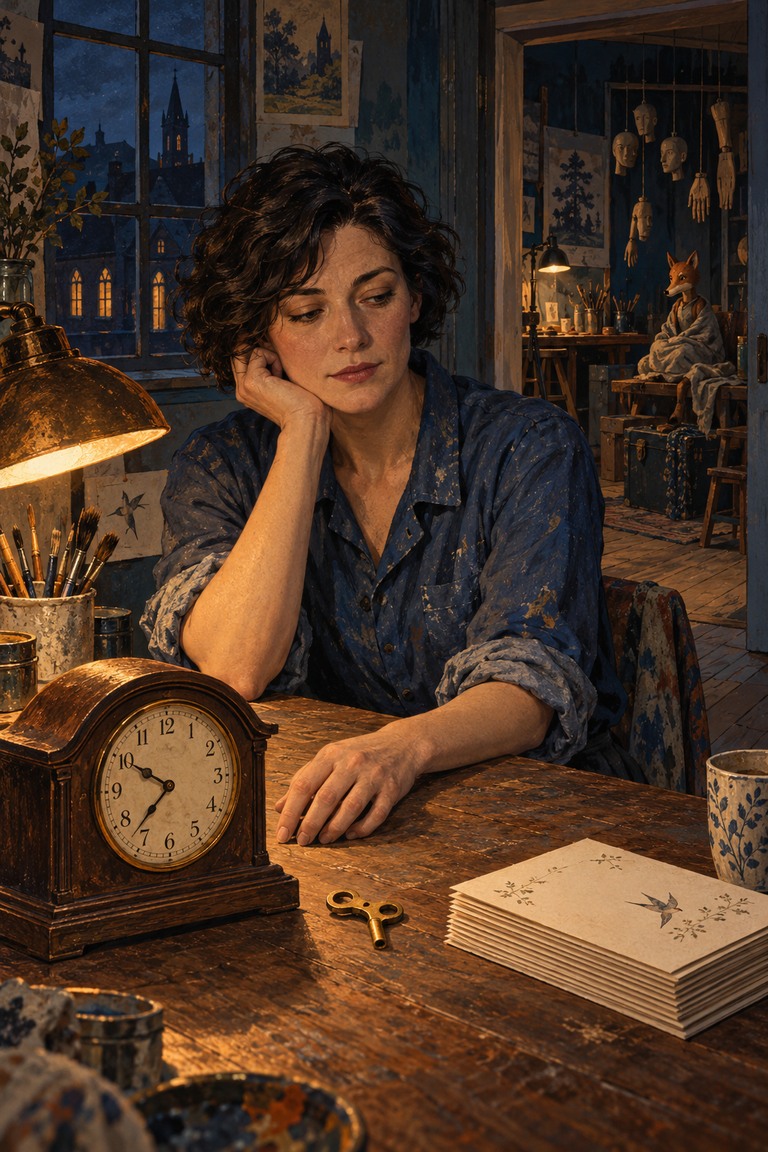
Their studio occupied two rooms above a shop that sold school uniforms. In the larger room stood Mina's workbench, a forest of suspended hands and wooden heads; in the smaller, Iris painted scenery and signs. They had been there for twelve years. At nine every morning Mina brought coffee upstairs, placing Iris's cup on the windowsill because the tables were never clear. At nine on this particular Thursday, she brought two coffees and an envelope. Iris saw the envelope before she saw that Mina was smiling. On the invitation, which lay between them, the little bird appeared to be watching for crumbs.
"I've found somewhere," Mina said. She slid out a photograph of a stone building with a broad door. It was a workshop in the town where her partner, Leila, had started teaching. There was space for evening classes, proper ventilation, and a ground-floor entrance through which a person could carry a puppet theatre without apologising to a staircase. Mina had mentioned looking for such a place. Iris had translated looking into dreaming, and dreaming into something that required a sympathetic nod but no alteration of the future. Now the keys would be ready on Friday. Mina would leave on Sunday, after the anniversary party on Saturday.
Iris looked at the photograph. "It must be cheap for a reason." The sentence came out with the brisk competence she used to warn clients about damp walls. Mina returned the photograph to its envelope. For a moment the two women could have been strangers disputing a delivery. Then Mina said that Leila had already visited the building, that a carpenter had checked the roof, and that she was telling Iris about a decision, not submitting an estimate. Downstairs, a child was protesting against a pair of trousers. His mother kept saying that he would grow. Iris almost laughed, which would have made matters worse.
The day diminished into practicalities. Mina wrapped puppet heads in tissue, and Iris went to the copy shop with the invitation. She had fifty copies printed without moving either name. At the studio, she found a notice from the landlord under the door: the tenancy would continue in Iris's name alone, at the same rent, if she confirmed by Friday. Mina had asked him to make the change. That kindness felt, to Iris, like evidence of a conspiracy. She placed the notice face down. Above it, the old clock they had bought from a second-hand shop stood on a shelf. Its hands had stopped at ten past six, years ago. A repairer had returned it that morning with a card attached to the winding key: TURN BACK ONCE. Iris had assumed this referred to loosening the mechanism after winding it.
By eleven that night, Mina had gone home and Iris was still upstairs. Fifty invitations were stacked beside the notice; a puppet's detached hand lay palm upwards on the workbench. Iris took the clock down, inserted the key, and wound until the spring resisted. Then she turned the key back once, as the card instructed. The clock gave a dry click. For several seconds the room seemed to incline, as though the building were a boat changing direction. Iris caught the edge of the table. When she opened her eyes, she was in bed at home. The alarm was ringing. Her phone said Thursday, eight o'clock, and the message she had sent Mina after their argument had vanished.
A More Generous Woman
At the studio, the invitation was still a single sheet. The landlord's notice had not arrived. On the shelf the repaired clock stood unwound, its card and key dangling from a string. Iris opened the photograph Mina had sent her two months earlier of a possible workshop, then closed it again. She knew that picture; it was a different building. At nine she heard footsteps, and Mina appeared with two coffees and the same envelope. The sight did something more disturbing than frighten Iris. It gave her confidence. Whatever had happened in the clock, she had been granted the advantage of knowing her cue.
"I've found somewhere," Mina said. Iris took the photograph carefully and admired the wide doorway. She asked about the roof, the classes, and Leila. These were good questions. She listened to the answers, which she had failed to hear the previous Thursday, and learned that Mina planned to teach adults who had never made anything with their hands. The first course would be called Monsters for Beginners. Mina said the title with a small defensive laugh. Iris laughed too, affectionately this time, and for an hour they were as they had been in their best years: generous with each other's improbable ideas, certain that a disaster could at least supply material.
Then Iris offered a plan. Mina could keep the new workshop and spend two days a week at the old studio. They could apply for the theatre contract Iris had been discussing with a touring company. Iris would do the scenery; Mina would build the creatures. The fee would pay for the train journeys. She had not secured the contract, and the company had not even asked for puppets, but these deficiencies seemed temporary. Mina's departure was the immediate emergency. Iris spoke more quickly as she described their proposed work, accumulating details that gave the plan the appearance of a fact. There would be storage, shared bookings, a cheerful timetable pinned above the kettle.
Mina put her cup down. "When would I live with Leila?" Iris said that weekends could remain free. "We have weekends now," Mina replied. "That's what we're trying to change." She sounded tired, though Iris had arranged everything so that she should sound relieved. Iris explained the money again. Mina pointed to a painted fox hanging above her bench, one of the creatures from their first show. "You remember how we moved its mouth? You held the wire, and I moved the head. It worked because neither of us tried to do both jobs." She stopped. "This isn't a timetable problem." Iris wished she had never asked about the doorway.
At the copy shop, she changed the invitation. Mina's name now occupied the whole lower half of the page, and Iris's had shrunk to a line above the date. The printer asked whether this was a farewell party. Iris said yes before realising that Mina had not called it that. She took the invitations back and displayed one on the workbench. Mina studied it, then asked whether Iris was expecting her to make a speech. "I thought you'd like it," Iris said. Mina rubbed a pale patch of old glue from her thumb. "I wanted to tell you about my workshop. I didn't want to be presented with my own disappearance." She did not raise her voice. Iris found that particularly unhelpful.
That evening, Iris ate a sandwich while sitting on a packing crate. The landlord's notice lay face down exactly where she had placed it the day before, which was also today. Nothing had improved except the quality of her opening performance. She had been warm, attentive, extravagant; beneath all three manners she had continued trying to prevent the same thing. At eleven she reached for the clock. The first time, she had expected only to hear it tick. Now she wound it deliberately, feeling the resistance of the spring, and turned the key back once. The dry click was followed by that impossible inclination of the room. She woke to the Thursday alarm with a fragment of sandwich still present in her memory, though there was no crumb on her pillow.
What Cannot Be Rehearsed
On the third Thursday, Iris did not go straight to the studio. She walked to the park where she and Mina had first tested a puppet too large to fit through their door. Iris had spent that afternoon holding its elbow while Mina crouched inside its body. They had made a terrible swan. Children followed it, delighted by the creature's efforts to appear dignified as its neck collapsed. The park had since acquired a new fence, and the bench where they had repaired the swan was gone. Iris sat on a different bench. She tried to decide which memory belonged to friendship and which to an arrangement for avoiding other kinds of loneliness. The distinction refused to sit still.
Her phone rang at nine. "Where are you?" Mina asked. Iris said she would be there soon. "I've got your coffee." There was ordinary irritation in Mina's voice, and ordinary affection beneath it. Neither had been ruined, though Iris had twice imagined their ruin. She arrived to find the invitation waiting beside the coffee and the envelope still closed. "Can I look?" she asked. Mina showed her the workshop. This time Iris let the conversation wander. There was a stream behind the building, an upstairs room too small for classes, and a neighbour who had offered Mina an ancient cabinet because he could no longer bear the sight of its handles. None of those details advanced a rescue plan. Iris listened anyway.
"I'm going to miss this," she said at last. Mina nodded. "So am I." Iris had wanted that admission on the first Thursday, but would probably have used it as permission to argue. Now she asked what Mina would miss. Mina mentioned the uniform-shop children, the light at the workbench, and the way Iris said a deadline was impossible while already measuring the fabric. Then she mentioned the summers when Iris's mother was ill, and Iris came upstairs simply to sit. "I don't think you remember those days as work," Mina said. "Neither do I." Iris looked down at the invitation. Her mother's illness had ended; the habit of needing Mina within reach had not.
Mina asked if Iris would visit the new workshop. Iris almost offered a date, a frequency, a promise large enough to occupy the absence. Instead she asked whether Mina would actually like a visitor during the first week. "Not during the first week," Mina said. "I'll have boxes everywhere, and Leila has already volunteered to complain about them." They laughed. Mina suggested the following month, when Iris could help devise a monster that was easy for beginners to construct. Iris said she would come for a day. The smaller promise felt less impressive and more possible. She noticed, with a discomfort close to relief, that she did not know precisely what they would do that day.
They spent the afternoon packing. The invitation remained unprinted. Mina found the swan's wooden beak in a drawer and held it to her own nose. Iris laughed so suddenly that she knocked a roll of tape onto the floor. When she bent to retrieve it, she saw Mina's packing list: tools, cloth, wire, kettle. Below them, fox had been written and crossed out. She asked about the fox. Mina said she had assumed Iris would want to keep it because she had painted its fur. Iris said she had assumed Mina would take it because she had built its mouth. They stood beneath it, both smiling at the inconvenience of having asked too late about an object that had belonged to them both for twelve years.
Iris fetched a screwdriver. Together they released the fox from its hook, then sat it on the table between them. Its fur was worn where performers had gripped it. Mina moved the mouth while Iris held the wire, and the fox appeared to object to the conversation. They decided that it would travel with Mina for the first course, and return for any future show Iris could arrange. The agreement required no prediction about the next twelve years. At the copy shop, Iris finally ordered fifty invitations. The names were the same size, side by side. Beneath the bird she added a line asking guests to bring an object they could make into a creature. She had asked Mina first. Mina had replied that a farewell party should at least give people something to do with their hands.
The Unwound Clock
At ten that night, Iris was alone upstairs. For the first time that Thursday, the landlord's notice lay face up. She had sent her confirmation, and received a brief reply. There was no ceremony in the exchange. The smaller room would still be hers; the larger would be empty for a while. She measured Mina's bench and sketched a possible arrangement for a weekend class, then crossed out two tables because the doorway would become blocked. Planning a room was easier than inhabiting it. She put the sketch away before it could become another promise. The invitations were ready for Saturday, and the fox had been wrapped in a blanket for its journey.
The clock stood on the shelf. Iris took it down. She had not inspected the repair card closely before; now she turned it over. The reverse was blank. There was no warning, no explanation, no sensible limit printed in tiny letters. Perhaps the spring contained a fault that belonged to the universe rather than to the repairer. Perhaps it would grant another Thursday, or a thousand, if she kept asking. Iris could think of things she had still said badly. When Mina described the neighbour's cabinet, she had interrupted. She had laughed too loudly at the beak. The visit she had promised might yet become an obligation neither of them wanted. She could improve those details. She was less certain what improvement would mean.
She placed the clock beside the invitations and set the winding key on the table without inserting it. The silence was disappointing. Iris had imagined that allowing time to continue would feel decisive, but the room merely remained a room, with paste on the floor and a mark where the fox had hung. She washed the two coffee cups. On the first Thursday, she had left them on the windowsill; on the second, she had hidden them in the sink beneath a plate. This time she dried them and put them on the shelf. Then she turned off the light, checked that the door was locked, and walked home through streets whose next morning she could no longer know.
Her alarm rang at eight. Friday appeared on the phone, so casually that Iris felt an unreasonable desire to shake it. Mina had sent a photograph at seven: the new keys, lying in Leila's hand. Iris began a message about locks and damp walls, deleted it, and wrote, "A splendid doorway. Send me a picture of the cabinet." A reply arrived while she was getting dressed. The cabinet was enormous, with brass handles like a row of embarrassed teeth. Mina had added, "Monsters already in residence." Iris laughed alone in her bedroom, still holding one sleeve of her shirt.
On Saturday, the guests made creatures from spoons, gloves, cardboard, and a damaged umbrella. Mina taught a shy man to move a glove's fingers with thread, while Iris helped a child attach ears to a saucepan. The party was untidy and too warm. Near the end, Mina said a few words about the twelve years, mentioning the swan and the summers when Iris's mother was ill. Iris found herself listening without preparing a better version. When they carried the boxes down on Sunday, the fox went through the door first. Mina brought it back briefly and opened its mouth against Iris's sleeve. "Tell her to visit," she said in the fox's dry little voice.
Upstairs, Iris placed both names on the inside of the studio door, using one of the spare invitations. Then she returned to the smaller room, where a client had left a sketch for a seaside backdrop. The sea in the drawing was narrow and blue, with insufficient space for an actor to stand. Iris laid a fresh sheet beside it. Across the landing, the larger room remained quiet; she had left its door open. At eleven that morning, she was still working. The unwound clock occupied its shelf, and outside the shop window someone was arguing about the length of a pair of trousers. Iris listened until the voices moved away. She drew the shore a little farther back.